I picked this book up as part of my flurry of buying books on December 31st, 2012 (I had a four hour layover). This book came personally recommended by George R. R. Martin and being a Science Fiction fan as well as a GRRM fan, I knew that I would have to pick it up at some point. After receiving it, the book languished on my shelf for a few months because I wanted to read the entire series together in one go. After the third book came out, I started reading this one (though it appears that there are a few more in the works).
James S. A. Corey is the penname of the writing team of Daniel Abraham and Ty Franck. Daniel Abraham is a relatively well known sci-fi and fantasy author while Ty Franck is GRRM's assistant. It seemed an odd paring and I wondered if the recommendation by GRRM was not quite as honest as it could have been. However, my distrust was misplaced.
In short, this is a really good book. I thoroughly enjoyed it. The action is well done and the setting is interesting. In an interview in the back of the book they say that most sci-fi falls into two categories: the near future with only a few changes or the far future where there are basically an incomprehensible number of changes. This book aims to fall in between the two. There are human settlements on Mars, the asteroid belt, and a few places beyond but the only real technobabble technology is the drive that the ships use to make travel times a little more reasonable. It is by no means faster than light, it just means that a trip from Earth to Mars can take weeks rather than months.
Similar to A Song of Ice and Fire (or The Gap Cycle, since this is sci-fi), each chapter follows a viewpoint character from the third person limited perspective. Unlike the previous two, this book (with the exception of the prologue) alternates back and forth between two characters. In the beginning this was frustrating because I was far more interested in the character that involved spaceships than the one living on an asteroid. Since the most recent series I read in this format was ASOIAF, it was slightly disconcerting because in ASOIAF all of the characters generally trend towards separating whereas in this book from 100 pages in it becomes clear that the characters are going to meet up pretty early on.
One of the other interesting parts about this novel was that it was certainly science fiction (hard to have a book with spaceships shooting at each other that isn't) but it also has elements of horror stories and detective stories which make it different than some other sci-fi novels. It is not hard sci-fi like Vernor Vinge or Alistair Reynolds, but it is pretty close.
This book was very fun read and I sped through it. I have high hopes for the sequels.
Overall, I would give this book a 96%.
Informal book reviews and general thoughts about books from someone who enjoys reading
OR
Poorly written reviews of well written books
Thursday, June 20, 2013
Thursday, June 13, 2013
The Short Novels of John Steinbeck
This book was a Christmas gift, from the same Christmas that Gravity's Rainbow came from. Luckily, this book was much more enjoyable. The book (as the title implies) is a collection of some of Steinbeck's novellas, none of which are more than ~100 pages. There are six novels in the book and, because I love to order things, I ranked them in amount I liked them from most to least.
1. The Moon Is Down
2. Cannery Row
3. Tortilla Flat
4. Of Mice and Men
5. The Pearl
6. The Red Pony
Since this book is really six novels, I will do a mini review of each one in the order that they are in the book (which is the order they were published in, not they order they were written in).
Tortilla Flat - I started this book with a little trepidation. Every time I start reading a book by a famous author, I feel slightly worried that I won't like it. How can I consider myself a good reader if I don't like famous author X? However, I was gratified when I liked this story. It is divided up into 17 bite sized chapters and they chronicle the adventures of a group of friends in the town of Tortilla Flat. It was an enjoyable read and the way the characters were written it seemed a little like br'er rabbit but with people.
The Red Pony - This book was really five short books. They all had the same characters but they wee relatively unrelated. It follows the adventures of a young boy on his family's farm. When I started it, I had hoped it would be similar to Shane. However, there was no such luck. None of the stories have the boy coming out very much the winner and that, combined with the less than happy ending of Tortilla Flat made me wonder if no Steinbeck story was going to end on a positive note. The end of Tortilla Flat was passable because it was one part of the whole story but The Red Pony just threw repeated trials and pains at the kid and it just kept getting worse for him. While it is certainly well written, it is hard to enjoy something where the main character's life just keeps going downhill.
Of Mice and Men - This is arguably the Steinbeck novel, either this or The Grapes of Wrath (which I haven't read yet). I was surprised at how short it was, clocking in at less than 60 pages. Perhaps that just shows how little space he needs to make his ideas known. The story was interesting and unique, certainly an artifact of its time. The lifestyle of his characters is uncommon in modern society. However, after reading the previous two stories immediately before it, the ending tone the ending was going to take was apparent from early on. I will admit that the ending was slightly spoiled by 11/22/63where they put on a play version of the novel. Despite this, the ending still had its surprises.
Tortilla Flat - I started this book with a little trepidation. Every time I start reading a book by a famous author, I feel slightly worried that I won't like it. How can I consider myself a good reader if I don't like famous author X? However, I was gratified when I liked this story. It is divided up into 17 bite sized chapters and they chronicle the adventures of a group of friends in the town of Tortilla Flat. It was an enjoyable read and the way the characters were written it seemed a little like br'er rabbit but with people.
The Red Pony - This book was really five short books. They all had the same characters but they wee relatively unrelated. It follows the adventures of a young boy on his family's farm. When I started it, I had hoped it would be similar to Shane. However, there was no such luck. None of the stories have the boy coming out very much the winner and that, combined with the less than happy ending of Tortilla Flat made me wonder if no Steinbeck story was going to end on a positive note. The end of Tortilla Flat was passable because it was one part of the whole story but The Red Pony just threw repeated trials and pains at the kid and it just kept getting worse for him. While it is certainly well written, it is hard to enjoy something where the main character's life just keeps going downhill.
Of Mice and Men - This is arguably the Steinbeck novel, either this or The Grapes of Wrath (which I haven't read yet). I was surprised at how short it was, clocking in at less than 60 pages. Perhaps that just shows how little space he needs to make his ideas known. The story was interesting and unique, certainly an artifact of its time. The lifestyle of his characters is uncommon in modern society. However, after reading the previous two stories immediately before it, the ending tone the ending was going to take was apparent from early on. I will admit that the ending was slightly spoiled by 11/22/63where they put on a play version of the novel. Despite this, the ending still had its surprises.
The Moon Is Down - In my opinion, this was the stand out novel in the collection. To be fair, this is the closest to the genre I normally read of any in the book. It is a story about a small town that gets invaded. The exact sides are kept obscured, though from some clues in the story (and the time it was written) it seems like it is a German invasion of a French town. The conversion of a normal people to guerrillas a bit at a time is fascinating to watch. In this story, the end is at least marginally more positive.
Cannery Row - This story is the majority of the book, pages-wise. It follows the inhabitants of a part of a town and their day to day trials and experiences. He makes the metaphor of the stories being like a flatworm crawling into a scientist's collection plate. They do add up to a coherent narrative, though there are some offshoots that don't really add anything. Because this story has so many characters, there are some likable characters for everyone. This novel closes out with for the most part, positive feelings, a first for this book. I am sure I will read the sequel, Sweet Thursday, at some point in the near future.
The Pearl - The final novel of the book felt a little like a letdown. After the (relatively) lengthy epic that was Cannery Row this shorter story that was very tight and concise had a very different tone and feel. As I prefer lengthy epics, this was somewhat less enjoyable. In addition, I found the characters and their situation somewhat hard to emphasize with, which always detracts from my enjoyment.
The book as a whole was very enjoyable. The two that I liked the least (The Pearl and The Red Pony) took up only about 20% of the book. However, the book would have been worth it even it was only those two stories and The Moon Is Down, which was superb. One complaint I had with the formatting of this book was that each page contained two justified columns of text rather than the normal full page. This was not really a problem it just made physically reading it slightly more awkward.
In the back of my copy of this book (which was from a used bookstore), there is a quote from Steinbeck, followed by "2:18:58". I don't know what the numbers mean. I considered date started or finished (the book came out in 1953) and also time started or finished but both of those seemed silly. Another option could have been the quotes location in the book but the quote is from another of Steinbeck's works and is not even found within the pages of this book let alone at 58 words into the 18th line of the second novel. The most logical choice seems to be time spent reading the book. It would be an interesting idea to time myself while I read but I feel like there are too many variables to get any meaningful data out of it.
The Pearl - The final novel of the book felt a little like a letdown. After the (relatively) lengthy epic that was Cannery Row this shorter story that was very tight and concise had a very different tone and feel. As I prefer lengthy epics, this was somewhat less enjoyable. In addition, I found the characters and their situation somewhat hard to emphasize with, which always detracts from my enjoyment.
The book as a whole was very enjoyable. The two that I liked the least (The Pearl and The Red Pony) took up only about 20% of the book. However, the book would have been worth it even it was only those two stories and The Moon Is Down, which was superb. One complaint I had with the formatting of this book was that each page contained two justified columns of text rather than the normal full page. This was not really a problem it just made physically reading it slightly more awkward.
In the back of my copy of this book (which was from a used bookstore), there is a quote from Steinbeck, followed by "2:18:58". I don't know what the numbers mean. I considered date started or finished (the book came out in 1953) and also time started or finished but both of those seemed silly. Another option could have been the quotes location in the book but the quote is from another of Steinbeck's works and is not even found within the pages of this book let alone at 58 words into the 18th line of the second novel. The most logical choice seems to be time spent reading the book. It would be an interesting idea to time myself while I read but I feel like there are too many variables to get any meaningful data out of it.
Overall, I would give this book an 89%.
Wednesday, May 29, 2013
Cicero
Having read, before this, Anthony Everitt's biographies of Hadrian and Augustus, I had a pretty good idea of what to expect from Cicero: an extremely readable and well researched account of the life and times of that famous historical figure. I was not disappointed. The book was more gripping than most non-fiction books that I have read. There was almost genuine suspense at the end (even though I knew what had to happen). While this covers the time period of Roman history that I know the most about, I think it was the most enjoyable of the three of his books that I have read.
Like his other books, in Cicero, Everitt discusses what happened before Cicero was born that influenced his life (in this case that would be basically the stories of Marius and Sulla) which provides important context for readers unfamiliar with Roman history. The book then proceeds through Cicero's life in chronological order in almost a story form. However, the author is quick to admit where something is a supposition or unclear.
This book is also interesting because, unlike the Roman Emperors of his later books, there is a large collection of Cicero's correspondence with his friends revealing a personal side of him that most famous figures have lost due to the attenuation of history. This is by no means a definitive look into his personality but it is certainly a clearer look than there is available for basically any one else in the period.
Unlike the other two biographies that I have read by him, this book did not go into the aftermath of Cicero's death in particular detail. However, I will forgive this fault because Augustus picks up at (technically slightly before) the end of this book.
If this book seems like a fun read, I also recommend Colleen McCullough's Masters of Rome series. It is a novelized version of basically the events of this novel, with a little before and a little after. It covers seven books and is very good.
Overall, I would give this book a 93%.
Saturday, May 18, 2013
The Ladies of Grace Adieu and Other Stories
Having gobbled up Jonathan Strange and Mr. Norrell I decided to read Ms. Clarke's other work that takes place in a similar world. The Ladies of Grace Adieu and Other Stories is a collection of short stories that are all written in the same style as her previous book. Some of them it is unclear if they take place in the same world while others directly involve some of the characters from Jonathan Strange and Mr. Norrell.
Like many short collections the quality is somewhat variable. I most enjoyed the first and last stories, the ones in between I thought fell a little short. Throughout the book there were glimmers of the stuff that made the other book so good, but I think that part of made that so good was the length of the book really let her flesh out the characters, the world, and the plot and her short stories really cannot do that in the same way.
If you liked Jonathan Strange and Mr. Norrell, this book will probably interest you. However, I would not really recommend reading it first. While the size of the other book is a little daunting, it is a much more interesting journey than this one.
Overall, I would give this book an 81%.
Like many short collections the quality is somewhat variable. I most enjoyed the first and last stories, the ones in between I thought fell a little short. Throughout the book there were glimmers of the stuff that made the other book so good, but I think that part of made that so good was the length of the book really let her flesh out the characters, the world, and the plot and her short stories really cannot do that in the same way.
If you liked Jonathan Strange and Mr. Norrell, this book will probably interest you. However, I would not really recommend reading it first. While the size of the other book is a little daunting, it is a much more interesting journey than this one.
Overall, I would give this book an 81%.
Saturday, May 11, 2013
Sucker's Portfolio
There are certain authors that I know that I will enjoy basically anything they write. As a consequence, I do not buy books by these authors very often because books by them are sold in basically every bookstore, no matter how small. That way if I underpack books for a vacation or some other similar circumstance, I can find books to read. Kurt Vonnegut is one of these authors. His latest book, Sucker's Portfolio, was on sale so I snatched it up. Since it was a collection of short stories, it seemed like a nice thing to read during the hectic end of semester weeks.
In addition to the short stories the book also included an "unfinished" science fiction story. I was interested to read this because, well, I like science fiction and I like Kurt Vonnegut. This was sort of a surprise because the story is clearly building up and then it abruptly ends in mid-sentence. Most of the time when unfinished work is published, it at least ends on a period but perhaps Mr. Vonnegut needed to go to the bathroom urgently or something.
One of the problems that I had with these stories were that none are particularly happy. In his full length books, Vonnegut can generally offset this with humor but in these stories that is somewhat lacking. They are still enjoyable, just do not expect to have a smile on your face when you finish them.
In summary, these are some stories that a Vonnegut fan would definitely enjoy. His style of writing shines through and it is a nice quick read. However, I can definitely see why these remained unpublished for so long. Someone who is new to Vonnegut would probably enjoy one of his other books more (Slaughterhouse-Five is a particular favorite of mine).
Overall, I would give this book an 85%.
Since this is the third collection published after his death, I was a little worried that they would be scraping the bottom of the barrel for things to include. However, some of the stories were very enjoyable. I thought that the first one was particularly interesting and was kind of a corollary to a Connie Willis book I like a lot, Passage.In addition to the short stories the book also included an "unfinished" science fiction story. I was interested to read this because, well, I like science fiction and I like Kurt Vonnegut. This was sort of a surprise because the story is clearly building up and then it abruptly ends in mid-sentence. Most of the time when unfinished work is published, it at least ends on a period but perhaps Mr. Vonnegut needed to go to the bathroom urgently or something.
One of the problems that I had with these stories were that none are particularly happy. In his full length books, Vonnegut can generally offset this with humor but in these stories that is somewhat lacking. They are still enjoyable, just do not expect to have a smile on your face when you finish them.
In summary, these are some stories that a Vonnegut fan would definitely enjoy. His style of writing shines through and it is a nice quick read. However, I can definitely see why these remained unpublished for so long. Someone who is new to Vonnegut would probably enjoy one of his other books more (Slaughterhouse-Five is a particular favorite of mine).
Overall, I would give this book an 85%.
Wednesday, May 8, 2013
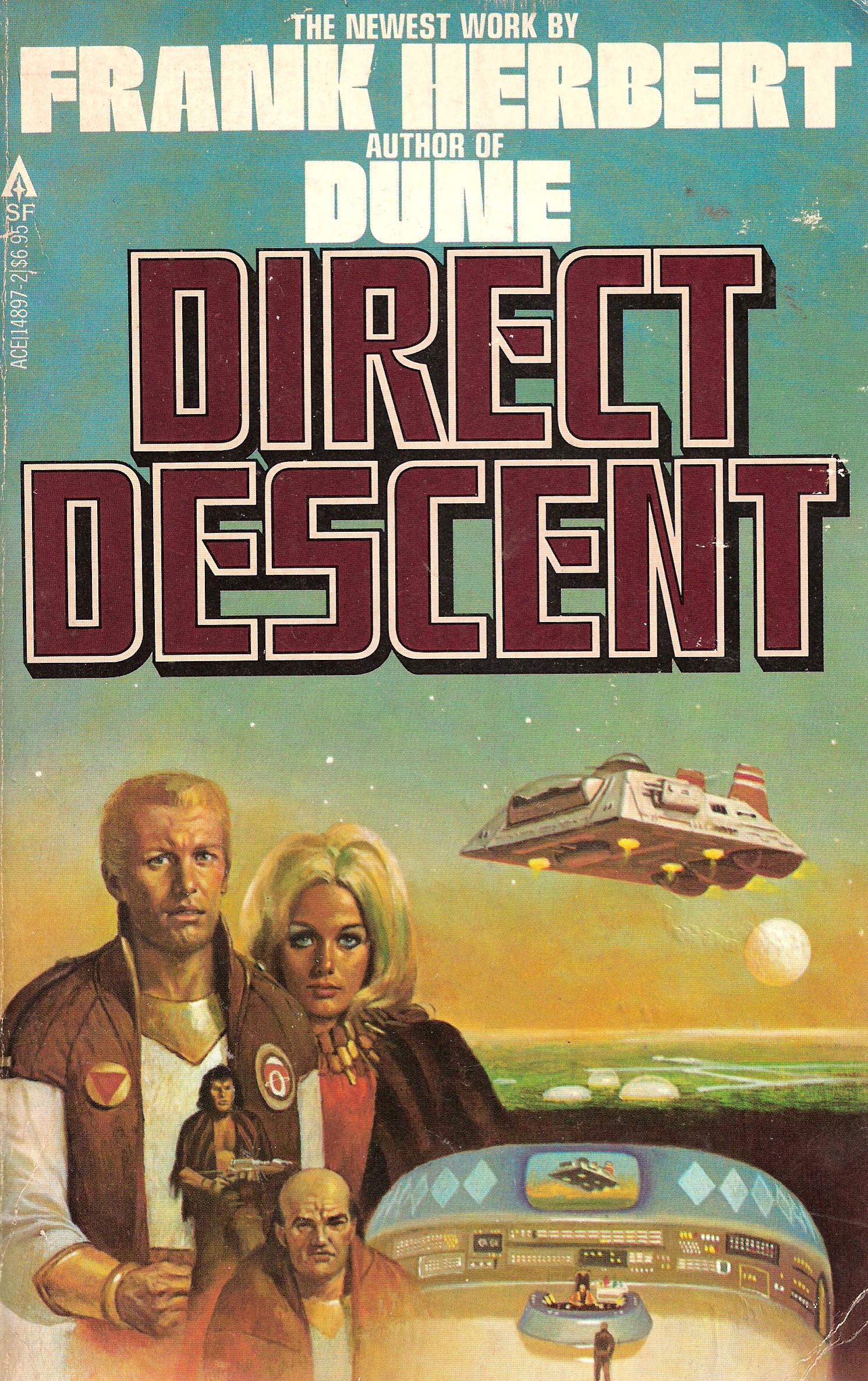
Direct Descent
I picked up Direct Descent at The Strand in New York City (which is a great bookstore and basically worth a trip to NYC in and of itself) in the same trip that I bought Anathem, Quicksilver, and The Lazarus Effect. I was just basically buying any Neal Stephenson or Frank Herbert books that I came across. Due to the shortness of this book it got pushed off and pushed off until I finally read it the other day. I can say with certainty that it was not at all what I expected.
It is two short stories both set in the same future where all of Earth has been excavated to make room for a gigantic library that holds the entirety of human knowledge. Both stories feature a malicious government attempting to repress the knowledge represented by a planet sized library. The concept is interesting and makes for an enjoyable pair of stories.
However, this book was clearly designed for more of the young adult crowd. The only reason that the stories take as many pages as they do is because there is about 1 (full page) picture every 2.1 pages. The text is also larger than it needs to be and the stories are a little simplistic, involving concepts like love at first sight and some hand-wavey explanations of things.
The concept is interesting but the execution is lacking. I think perhaps if I had read this 14 or 15 years ago, I might have enjoyed it more but as it stands it just seemed a little too childish.
Overall, I would give this book an 81%.
It is two short stories both set in the same future where all of Earth has been excavated to make room for a gigantic library that holds the entirety of human knowledge. Both stories feature a malicious government attempting to repress the knowledge represented by a planet sized library. The concept is interesting and makes for an enjoyable pair of stories.
However, this book was clearly designed for more of the young adult crowd. The only reason that the stories take as many pages as they do is because there is about 1 (full page) picture every 2.1 pages. The text is also larger than it needs to be and the stories are a little simplistic, involving concepts like love at first sight and some hand-wavey explanations of things.
The concept is interesting but the execution is lacking. I think perhaps if I had read this 14 or 15 years ago, I might have enjoyed it more but as it stands it just seemed a little too childish.
Overall, I would give this book an 81%.
Tuesday, May 7, 2013
Agent of Byzantium
Agent of Byzantium is a collection of short stories that take place in an alternate timeline where the Byzantine Empire did not fall. The book takes place around 1300 AD and follows one particular citizen who works as sort of a James Bond-esque character for the government. The stories are certainly interesting and definitely left me wanting more.
The book starts with an introduction by Isaac Asimov where he discusses his love of alternate history stories. He talks about how he would like to see one where Einstein's letter to Roosevelt arrived a day later. This would put its arrival on Pearl Harbor Day when a response probably would have been delayed or lost in the shuffle. I thought that that was a really interesting idea and it was nice to read Asimov's reasoning behind "presenting" this book.
The part of history that is changed so that the Empire never fell is that Mohammed, instead of founding Islam, converted to Christianity and became a Christian saint. With this change, the Muslims never become a significant military force and never pressure the Empire. In addition, this means that the Persian Empire never fell either. This means that, throughout the book, Byzantium and Persia are engaged in a cold war. This matters more in some of the stories than others.
Each of the stories basically has a gimmick, some (more) modern invention that is discovered by the protagonist that shapes the story. In one, he finds a telescope and another has him finding a printing press, among several other stories. I understand that that was a nice gimmick that allowed even someone without a strong grasp of history to be involved in the story because they could recognize the modern inventions. However, I cannot help but feel that this at least somewhat implies that technology would have progressed faster without Islam, which is not a sentiment that I like as much.
It was interesting to read this so close to the end of the Mongoliad because they take place in similar time frames and it was exciting to see some of the similar things between the stories (though Mongoliad had much better combat). In this book, the protagonist spends some time living among the mongols which resembled some of Gansukh's chapters in Mongoliad.
There is certainly nothing wrong with the stories in this book. The biggest problem is that there are only five. I wish that the book had been either a full novel rather than short stories or at least a lead in to a larger exploration to this alternate timeline. Sadly, Mr. Turtledove has not done any such thing (at least not yet).
Overall, I would give this book an 87%.
The book starts with an introduction by Isaac Asimov where he discusses his love of alternate history stories. He talks about how he would like to see one where Einstein's letter to Roosevelt arrived a day later. This would put its arrival on Pearl Harbor Day when a response probably would have been delayed or lost in the shuffle. I thought that that was a really interesting idea and it was nice to read Asimov's reasoning behind "presenting" this book.
The part of history that is changed so that the Empire never fell is that Mohammed, instead of founding Islam, converted to Christianity and became a Christian saint. With this change, the Muslims never become a significant military force and never pressure the Empire. In addition, this means that the Persian Empire never fell either. This means that, throughout the book, Byzantium and Persia are engaged in a cold war. This matters more in some of the stories than others.
Each of the stories basically has a gimmick, some (more) modern invention that is discovered by the protagonist that shapes the story. In one, he finds a telescope and another has him finding a printing press, among several other stories. I understand that that was a nice gimmick that allowed even someone without a strong grasp of history to be involved in the story because they could recognize the modern inventions. However, I cannot help but feel that this at least somewhat implies that technology would have progressed faster without Islam, which is not a sentiment that I like as much.
It was interesting to read this so close to the end of the Mongoliad because they take place in similar time frames and it was exciting to see some of the similar things between the stories (though Mongoliad had much better combat). In this book, the protagonist spends some time living among the mongols which resembled some of Gansukh's chapters in Mongoliad.
There is certainly nothing wrong with the stories in this book. The biggest problem is that there are only five. I wish that the book had been either a full novel rather than short stories or at least a lead in to a larger exploration to this alternate timeline. Sadly, Mr. Turtledove has not done any such thing (at least not yet).
Overall, I would give this book an 87%.
Subscribe to:
Posts (Atom)