Showing posts with label Biography. Show all posts

Sunday, February 9, 2014

Hyperbole and a Half

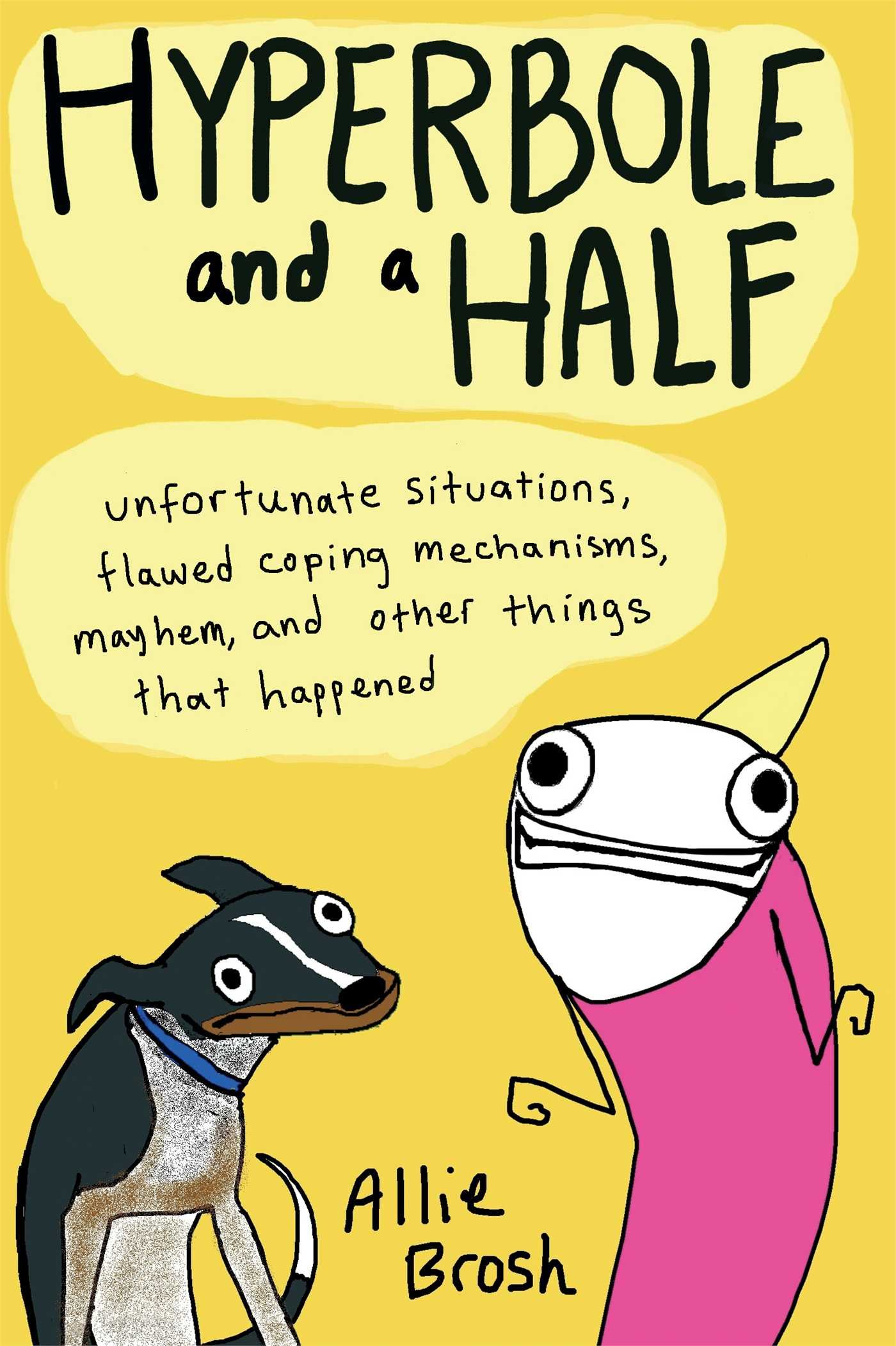
Hyperbole and a Half was a Christmas gift.  I had never heard of Allie Brosh or her blog (also called Hyperbole and a Half) and I have to say the cover made me slightly worried.  The combination of the subtitle ("unfortunate situations, flawed coping mechanisms, mayhem, and other things that happened") combined with the childish style of art on the cover left concerned that this could be a very unfunny book.  I was completely and utterly wrong.

See, this could be a little troubling with no context, right?

This book had me laughing incredibly hard at multiple points.  The book is formatted as a collection of her blog posts as well as some original stories (which seems to be par for the course for internet writers).  The best chapter is probably the first, where she finds a letter to her present self from her 10 year old self.  I was laughing so much my gut hurt all the way through that chapter and there are many other chapters that are nearly as funny.

There are, however, some serious chapters in the book as well.  Some of them are covered under a veil of comedy like those about her lack of motivation and the rules that she imagines the world lives by. These are humorous but still have the capacity to make the reader think.

Then there are the chapters on depression and her self-identity .  These four chapters comprise a significant fraction of the book, two of them are placed in the middle and two at the very end.  They take issues that are serious and personal and explain what it is like to experience them in a way that still has just enough jocularity to make it not scary or self-pitying.  In fact, while I loved the funny parts, I think the primary thing that I will take away from this book is the exploration of depression.  It was a fascinating read and will probably come to mind when I think of depression for years.

I really liked this book, both at its serious points and its funny points.  I have added the corresponding blog to my RSS reader and I hope that is updated frequently as her art and writing style is highly entertaining.

Overall, I would give this book a 94%.


Thursday, November 7, 2013

The Boat

This book is the original novel the famous movie Das Boot is based upon.  If you have not seen the movie, as I have not, it is the story of German U-boat crew and their adventures in the Atlantic and Mediterranean.  While that description makes it sound like a lighthearted romp, it is anything but.  The entire crew and the boat get pushed to their breaking points and beyond.


The author of the book actually served on a U-boat and he says that while the novel is fictional it is very closely based on real events. The author felt so strongly about this that he complained bitterly when the movie further dramatized the events to make it more exciting.

The book provides some interesting statistics as well.  Out of the 40,000 men who manned u-boats and terrorized the shipping lanes, 30,000 of them never returned.  That is a truly awful ratio.  Another troubling thing that most people do not think about  is how young everyone was.  The book implies that most people serving on submarines were under 20 years old.  However, after reading the book that is somewhat understandable because anyone suffering even the slightest bit from age would probably not be able to hold up under the constant pressure (literal and otherwise).

While I know a fair bit about World War II, most of my knowledge is confined to the land battles.  I did not know that U-boats were vastly different than modern submarines, which spend most of their time underwater.  U-boats spent most of their time on the surface, only going underwater to attack or to avoid being spotted.

I think the thing that I will remember most about this book is that it managed to portray German soldiers in World War II not as Nazis, not as men just following orders, but as tired boys just trying to do their jobs and make it home.   The sufferings of the crew, like not being able to sleep because they are battered by a massive storm for days on end, are really brought to life by the author and descriptions like the green rings around the Chief Engineer's eyes from sleep loss are enough to make one cringe.

Overall, I would give this book an 89%.

Wednesday, May 29, 2013

Cicero

Having read, before this, Anthony Everitt's biographies of Hadrian and Augustus, I had a pretty good idea of what to expect from Cicero: an extremely readable and well researched account of the life and times of that famous historical figure.  I was not disappointed.  The book was more gripping than most non-fiction books that I have read.  There was almost genuine suspense at the end (even though I knew what had to happen).  While this covers the time period of Roman history that I know the most about, I think it was the most enjoyable of the three of his books that I have read.


Like his other books, in Cicero, Everitt discusses what happened before Cicero was born that influenced his life (in this case that would be basically the stories of Marius and Sulla) which provides important context for readers unfamiliar with Roman history.  The book then proceeds through Cicero's life in chronological order in almost a story form.  However, the author is quick to admit where something is a supposition or unclear.

This book is also interesting because, unlike the Roman Emperors of his later books, there is a large collection of Cicero's correspondence with his friends revealing a personal side of him that most famous figures have lost due to the attenuation of history.  This is by no means a definitive look into his personality but it is certainly a clearer look than there is available for basically any one else in the period.

Unlike the other two biographies that I have read by him, this book did not go into the aftermath of Cicero's death in particular detail.  However, I will forgive this fault because Augustus picks up at (technically slightly before) the end of this book.

If this book seems like a fun read, I also recommend Colleen McCullough's Masters of Rome series.  It is a novelized version of basically the events of this novel, with a little before and a little after.  It covers seven books and is very good.

Overall, I would give this book a 93%.

Sunday, March 17, 2013

Hadrian and the Triumph of Rome

I was first exposed to the wonders of ancient Rome by Colleen McCullough's Master's of Rome series which is a novelized version of the key events in the Roman Republic in its twilight from 110 BC to 27 BC (after which it became the Roman Empire which endured for another ~5 centuries).  It is a great series and basically single handedly sparked my interest in ancient Rome.  Since then I have read a lot of different books (non-fiction and otherwise) about the Roman Republic and, subsequently, Empire.  Of these, my favorite is definitely Anthony Everitt's Augustus.  It a detailed journey through everything that has been unearthed about Augustus and his reign but it is written in such a way that it feels much more like a story than a textbook.

After reading Augustus, all of Anthony Everitt's books have been on my list of things to look for at a used book store especially Cicero because, due to Ms. McCullough's writing, the end of the republic is my favorite time in Roman history (though the parallelisms to Star Wars don't hurt).  I haven't found Cicero yet but I did find the "sequel" to Augustus in a stack off to the side in a used book store in Victoria.  Not wanting to pass up any Everitt book, I grabbed Hadrian and the Triumph of Rome.


Hadrian and the Triumph of Rome follows Hadrian through his life while also explaining the shaping circumstances of his life.  This means that this book spends a lot of time talking about the previous two emperors, Nerva and Trajan who were the first two of the "Five Good Emperors" (making Hadrian the third) which created a great setup to Hadrian's eventual ascension and added some really interesting parts that would have been lacking from the book if the discussion had only covered Hadrian's time as emperor (next time I am in Rome, I am definitely paying more attention to Trajan's column).

Like Augustus, this book follows Hadrian from his birth to shortly after his death in more of a story style than a textbook.  Everitt is quick to admit what we do not know but he makes suppositions to fill in the blanks, always explaining why he thinks what he does.  Hadrian is not quite the key figure in Roman history that Augustus was, so this book was less interesting but it was still a fascinating read and a great window into the days of Rome.

Overall, I would give this book an 88%.

Sunday, May 13, 2012

Richard Road: Journey From Hate

Richard Road, by Lud Gutmann, is a very interesting book.  I have the good fortune to know the author personally but I will try not to let it bias my thoughts.  This book is intended to be a memoir of the authors young life, something like Trevanian's The Crazy Ladies of Pearl Street.  Unlike Trevanian's book, this story is only slightly novelized, with all of the characters maintaining their real names and events as well as the author can remember them.
The book starts in Germany in the 30's.  The author's Jewish parents are becoming increasingly nervous with the Nazi regime.  This part of the book truly shines.  The harrowing experiences and all the things that happened could probably have filled their own book.  This is also the part of the book that is the most heavily novelized because the author was a toddler at the time and did not have his own memories to go off of.


However, that is not what the book is about.  The escape from Germany is simply prologue to real story the book wants to tell: what it was like to be a Jewish farmer in New Jersey.  Unfortunately, this subject matter did not interest me nearly as much as the earlier part of the book.  There were some funny parts and some sad parts and it serves as an excellent period piece for life in 40's and 50's New Jersey.

The real issue with this book is that it appears to want each chapter to be self-contained.  Information is repeated multiple times throughout the book, unnecessarily.  In addition multiple chapters go off on tangents near the end, which provide interesting information, but ruin the flow onwards to the next chapter.  All of this would be OK if the book was set up or billed as a collection of short stories but it is not.

Despite this, the book was interesting overall and it does an excellent job of painting the childhood of the author.  If the phenomena of Jewish farmers in New Jersey interests you (as it does some people) you will probably gobble this book up.  If stories of Jews in World War II interest you, this book will be enjoyable.  If biographies of early life are something that is enjoyable for you to read, then this is a fair sample of the genre.  Otherwise, this book is probably not for you.

I would give this book a 70% overall.