Warning:
While I try to keep these posts as spoiler free as possible, when
discussing the later books in a series, it is difficult to avoid
spoiling details of the earlier ones (though with Narratives of Empire you will probably get more spoilers from a passable knowledge of American history).
Hollywood is our fifth stop on our journey through the Narratives of Empire series (it would be the sixth if I was reading in publication order). It is also, unfortunately, my least favorite volume in the series. This is not to say it is bad but I think it is a clear outlier considering how much I enjoyed the rest of the series.
Caroline Sanford, who spent the last book assertively establishing a newspaper empire and competing with her brother now throws it all away to move to Hollywood and work in the movie business with William Randolph Hearst from the last book.
While this book covers the United States' entry into World War I and the aftermath, splitting the action between Hollywood and DC doesn't do the pacing any favors. I also found the Hollywood parts of the book just less compelling. Perhaps someone with a greater appreciation for film history would enjoy it more, but I found it lacking.
I can understand that it kind of follows a similar format to Empire in that it takes a more social perspective to formative events in American history but it doesn't feel like it works as well. Also, Caroline Sanford being a producer and an actor and being willing to give up her newspapers seems like an unrealistic character change.
Overall, I would give this book an 81%.
Informal book reviews and general thoughts about books from someone who enjoys reading
OR
Poorly written reviews of well written books
Saturday, December 23, 2017
Tuesday, December 19, 2017
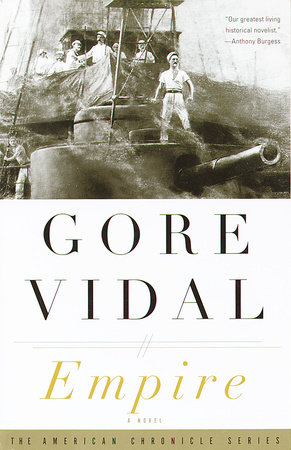
Empire
Warning: While I try to keep these posts as spoiler free as possible, when discussing the later books in a series, it is difficult to avoid spoiling details of the earlier ones (though with Narratives of Empire you will probably get more spoilers from a passable knowledge of American history).
Empire is a strong contender for my favorite volume in the series (Lincoln being its strongest competitor) but it introduces my favorite character, Caroline Sanford. She and her brother are the latest descendants of the Schulyer family and they are pitted against each other in the age of yellow journalism. Her ambition is most of the driving force in the novel and Vidal manages to make her triumphs feel appropriately hard fought.
This volume interested me more because it focused less on the global events at the beginning of the 20th century (though still a fair amount, "Empire" is the title) and more on the social, with which I was less familiar. I didn't really know much about the Hearst news empire (owned by the child of the villain of Deadwood) and the social struggles around McKinley and Theodore Roosevelt's presidential runs.
As with all the books in the series, you could probably pick it up and start here. However, this one has more connections to the previous volumes than some of the others. Like the others though, it is a highly enjoyable read steeped in the characters and politics of the time.
Overall, I would give this book a 90%.
Tuesday, January 5, 2016
1876
Warning: While I try to keep these posts as spoiler free as possible, when discussing the later books in a series, it is difficult to avoid spoiling details of the earlier ones, (though with Narratives of Empire you will probably get more spoilers from a passable knowledge of American history).
In our continuing journey through Gore Vidal's Narratives of Empire brings us to 1876, the third published and the third chronologically. This is much more of a direct sequel to Burr than Lincoln was and bridges the gap between Burr and the first book published, Washington D.C. (You could consider Narratives of Empire in publication order as two trilogies, with the misfit Lincoln between them. Anyway, enough discussion of the series, on to the book!
Overall, I would give this book an 89%.
In our continuing journey through Gore Vidal's Narratives of Empire brings us to 1876, the third published and the third chronologically. This is much more of a direct sequel to Burr than Lincoln was and bridges the gap between Burr and the first book published, Washington D.C. (You could consider Narratives of Empire in publication order as two trilogies, with the misfit Lincoln between them. Anyway, enough discussion of the series, on to the book!
While Gore Vidal's cynical eye generally portrays an America that is probably more true than I would like, his coverage of the year 1876, what he calls "probably the low point in our republic's history" is particularly painful. Grant is another historical figure I found interesting, I read his memoirs and enjoyed them, but there is a reason that they end at the end of the civil war and don't continue into his political career.
I generally try to give people the benefit of the doubt, but the character of Grant in this book gets very little wiggle room around his corruption and the problems in his administration. This book could easily have been entirely about Grant's administration like a dark mirror to Lincoln but instead the author has tried to give us a slightly wider view of what is going on, which has its pluses and minuses.
Our narrator from Burr returns, now an appropriately old man. As an interesting choice, Vidal makes him quite the unreliable narrator. He ignores signs that are right in front of him and has difficulty remembering things. In an interesting case of parallelism, the corruption of the United States is matched by the corruption in the narrator's brain. His self-delusion and absent-mindedness perhaps match the country's delusion that, at that point in history, America was still a great nation.
Overall, I would give this book an 89%.
Monday, January 4, 2016
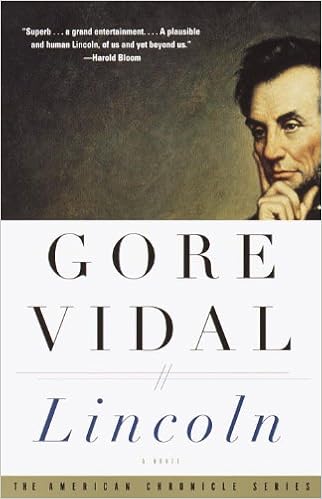
Lincoln
Warning: While I try to keep these posts as spoiler free as
possible, when discussing the later books in a series, it is difficult to avoid
spoiling details of the earlier ones, (though with Narratives of Empire you
will probably get more spoilers from a passable knowledge of American history).
Lincoln is the second book of Narratives of Empire chronologically but the 4th published. It is far and away the least related to the rest of the series, only a couple reoccurring characters from Burr and the introduction of a few characters that play significantly larger roles in later volumes even merit it admission into the series. If you were solely interested in the plot of the saga, this would be the volume to skip. But why would you?
Even if you aren't a completionist like me, anyone who would enjoy the rest of the series would definitely enjoy this book. Its loving look at Lincoln from those around him is a total contrast to the frustrated look at Jefferson in Burr and is a delight to read. Of course, it doesn't go easy on him, I'm not sure Gore Vidal is capable is going easy on anyone, but you can tell had great respect and regard for Lincoln.
The book has only one viewpoint from Lincoln and all the rest are from the people around him, with his secretary John Hay as one of the most frequent (due in large part to the fact that Hay's autobiography was one of the major sources for the book). I am not sure I have ever read a book quite like it with all the viewpoints focused on a single person without hearing from them directly, it has the interesting effect of making you feel like you are orbiting some celestial object and observing it from all sides.
The book is also an interesting take on the Civil War as it goes through Lincoln's presidency and a little beyond, however it rarely shows any of the battles. The reader learns about them as Lincoln does, from messengers and telegrams. "Atlanta is ours and fairly won" has a stronger resonance when you don't see Sherman take the city and are waiting nervously at the White House with the president.
This book is historical fiction and thus has some inaccuracies though what and how much were hotly debated by Gore Vidal. While it isn't perfect, it definitely is an entertaining read and a welcome addition to any history nerd's bookshelf.
Overall, I would give this book a 92%.
Monday, December 28, 2015
Burr
Aaron Burr has always been a sort of favorite of mine. Not in the sense that he was a role model or anything like that; a man who is, by many accounts, a traitor and a sore loser doesn't seem suited to that sort of favoritism. Instead, I liked him because he was a quirk of history, he managed to interact and work with many of the founding fathers of America, without ever being considered one. It seems he was a skilled lawyer and politician but he burned the wrong bridges (and shot the wrong people) and ended up on the wrong side of history.
These were the things I was thinking when I saw Burr by Gore Vidal among my grandmother's books. After a quick google which told me that it was the first of a 7 book series (as always if I can help it, I read the series in historical order rather than publication order (Burr is second in publication order)), I shelved it for some years until I was in the mood to read something longer. When I finally hit that point, I was delighted at how good it was. Gore Vidal was just a familiar name to me before I started this series but now he is an author I respect.
The book is highly enjoyable: the characters are engaging, and while the plot is mostly a frame story, it makes history interesting. It is not the best book in the series (that honor probably goes to Lincoln or Empire) but it is in the top half of a set of seven good books. Plus, it makes for the perfect gift for anyone who is annoying you by singing Hamilton lyrics too much.
Overall, I would give this book a 90%.
These were the things I was thinking when I saw Burr by Gore Vidal among my grandmother's books. After a quick google which told me that it was the first of a 7 book series (as always if I can help it, I read the series in historical order rather than publication order (Burr is second in publication order)), I shelved it for some years until I was in the mood to read something longer. When I finally hit that point, I was delighted at how good it was. Gore Vidal was just a familiar name to me before I started this series but now he is an author I respect.
The book is historical fiction and follows Burr in the twilight of his life recounting adventures from his younger years. As you might expect from the title, it generally puts him in a sympathetic light. After reading the rest of the series, I've determined that Vidal is somewhat of a historical contrarian. If history says someone is good, Vidal probably portrays them less kindly in his books and, to Burr's benefit, someone history frowns upon gets a more positive spin. This makes for a particularly interesting read for someone like me who generally goes after the breadth of history rather than the depth of particular parts.
The book is highly enjoyable: the characters are engaging, and while the plot is mostly a frame story, it makes history interesting. It is not the best book in the series (that honor probably goes to Lincoln or Empire) but it is in the top half of a set of seven good books. Plus, it makes for the perfect gift for anyone who is annoying you by singing Hamilton lyrics too much.
Overall, I would give this book a 90%.
Saturday, December 26, 2015
What If?
First let me start by saying that Randall Munroe's what if blog is one of the treasures of the internet. If you have never heard of it, he does back of the napkin calculations for generally silly questions. Some of my favorites include
1) How many BBs would it take to stop a speeding train: http://what-if.xkcd.com/18/
2) How to build a jetpack out of downward firing machine guns: http://what-if.xkcd.com/21/
3) Changing the color of the moon with laser pointers (which contains the phrase
Anyway, this book is a collection of his posts and some original content. It is interesting when things people are giving away for the free on the internet (webcomics, blogs, and the like) transition into money making in the physical world. It is interesting to see what twists the author puts on their product to make it worth buying rather than reading for free on the internet. In this case, it is some new questions and answers. However, honestly they are (in my opinion, duh) some of the worse ones of the book. They are still good, but definitely not in my favorites.
If you want to know the real answer to questions like "How many BBs can stop a train?", this isn't the book for you. The math is generally back of the napkin style and many of the concepts are oversimplified to the point of being unrecognizable by an expert. However, if you want to think about interesting questions with reasonable simulacra of the answers, this is exactly the book for you. The author has a humorous tone and is clearly having fun researching and writing the answers. As such, the book is best suited to someone who wants to have fun reading it (and honestly, it is hard not to),
While this is a great concept and a fun book, if you are even moderately internet savvy, you can get 90% of the enjoyment from this book simply by reading the blog.
Overall, I would give this a 90%.
1) How many BBs would it take to stop a speeding train: http://what-if.xkcd.com/18/
2) How to build a jetpack out of downward firing machine guns: http://what-if.xkcd.com/21/
3) Changing the color of the moon with laser pointers (which contains the phrase
): http://what-if.xkcd.com/13/Unfortunately, the laser energy flow would turn the atmosphere to plasma, instantly igniting the Earth’s surface and killing us all.But let’s assume that the lasers somehow pass through the atmosphere without interacting.Under those circumstances, it turns out Earth still catches fire.
Anyway, this book is a collection of his posts and some original content. It is interesting when things people are giving away for the free on the internet (webcomics, blogs, and the like) transition into money making in the physical world. It is interesting to see what twists the author puts on their product to make it worth buying rather than reading for free on the internet. In this case, it is some new questions and answers. However, honestly they are (in my opinion, duh) some of the worse ones of the book. They are still good, but definitely not in my favorites.
If you want to know the real answer to questions like "How many BBs can stop a train?", this isn't the book for you. The math is generally back of the napkin style and many of the concepts are oversimplified to the point of being unrecognizable by an expert. However, if you want to think about interesting questions with reasonable simulacra of the answers, this is exactly the book for you. The author has a humorous tone and is clearly having fun researching and writing the answers. As such, the book is best suited to someone who wants to have fun reading it (and honestly, it is hard not to),
While this is a great concept and a fun book, if you are even moderately internet savvy, you can get 90% of the enjoyment from this book simply by reading the blog.
Overall, I would give this a 90%.
Friday, August 14, 2015
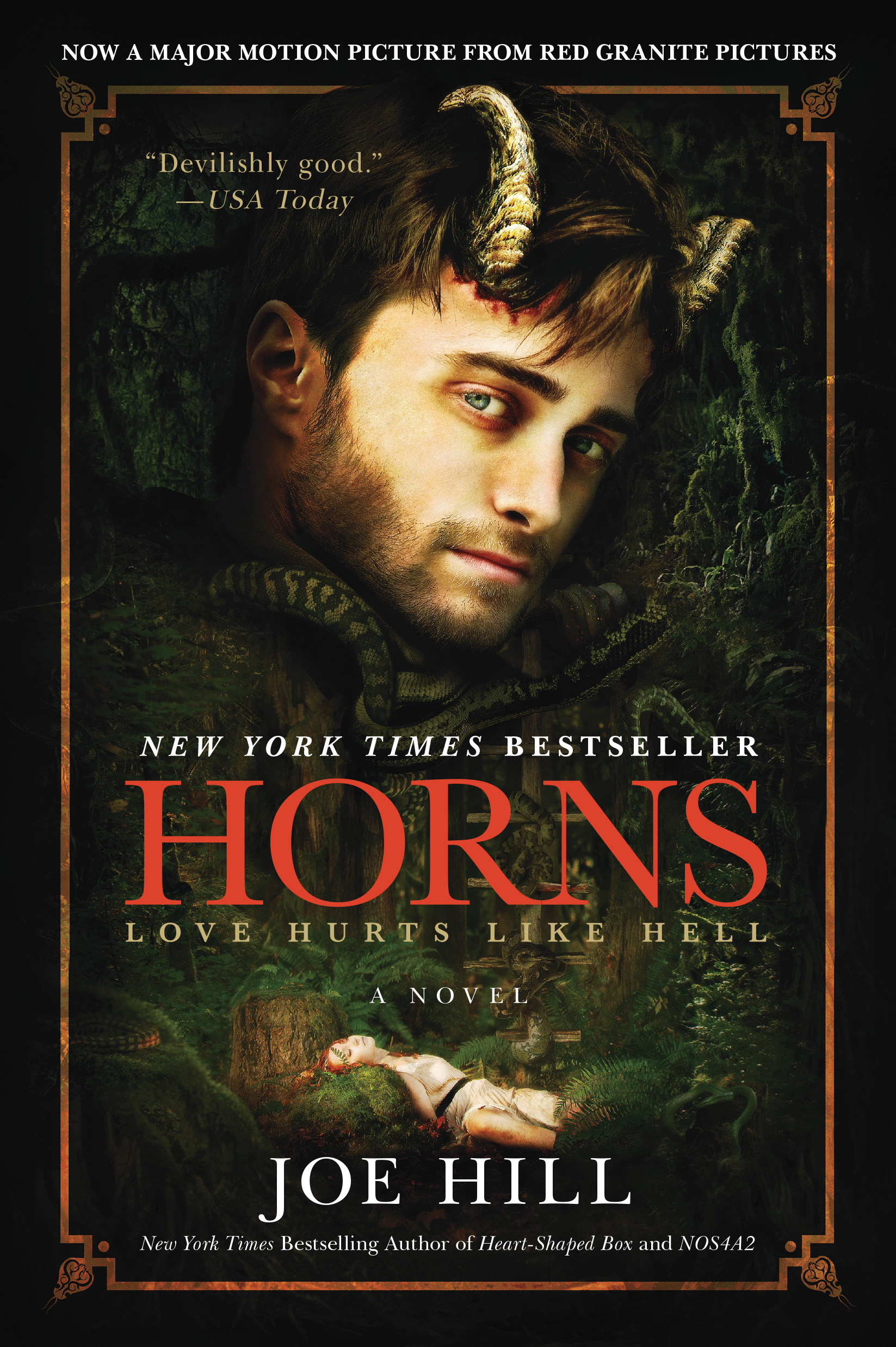
Horns
Horns was a book that spiked in popularity last year due to a movie based it that starred Daniel Radcliffe. I didn't actually see the film but I read the book because a friend had and wanted to discuss it.
The basic plot is that the protagonist wakes up one morning with, you guessed it, horns. He quickly realizes that these horns have powers that affect the people around him and much of the book is an exploration of those powers.
Horns' protagonist, while not fundamentally unlikable, generates a lot of pity. He has lived a rough life and, as such, doesn't use his powers in the best possible way. However, he shies away from being completely evil, avoiding my complete disgust,
The book was billed as a horror story but there isn't really very much scary stuff going on. Instead of keeping you up at night worrying someone will come after you with a hacksaw, you are more likely to be kept up wrestling with the worst of human nature. (Despite what I said about a lack of actual scary parts, there is one place where the reader is reminded that the brain is a physical object that can be damaged without being destroyed, a concept that always troubles me.)
The book also has a quote that I really enjoyed. "When the world comes for your children with its knives out, it is your job to stand in the way. Everyone knows that." This quote, while it comes at a trying time in the book, is representative of the parent I want to be when taken out of context like this.
To summarize, while this book has an interesting concept or two, there isn't really that much special there, It sits squarely in the no man's land between good and bad, without making huge leaps towards either side.
Overall, I would give this book an 81%.
The basic plot is that the protagonist wakes up one morning with, you guessed it, horns. He quickly realizes that these horns have powers that affect the people around him and much of the book is an exploration of those powers.
Horns' protagonist, while not fundamentally unlikable, generates a lot of pity. He has lived a rough life and, as such, doesn't use his powers in the best possible way. However, he shies away from being completely evil, avoiding my complete disgust,
The book was billed as a horror story but there isn't really very much scary stuff going on. Instead of keeping you up at night worrying someone will come after you with a hacksaw, you are more likely to be kept up wrestling with the worst of human nature. (Despite what I said about a lack of actual scary parts, there is one place where the reader is reminded that the brain is a physical object that can be damaged without being destroyed, a concept that always troubles me.)
The book also has a quote that I really enjoyed. "When the world comes for your children with its knives out, it is your job to stand in the way. Everyone knows that." This quote, while it comes at a trying time in the book, is representative of the parent I want to be when taken out of context like this.
To summarize, while this book has an interesting concept or two, there isn't really that much special there, It sits squarely in the no man's land between good and bad, without making huge leaps towards either side.
Overall, I would give this book an 81%.
Subscribe to:
Posts (Atom)