As you can see from my last post I've spent a lot of time reading and thinking about the Revelation Space series recently. I've liked Alastair Reynolds since House of Suns. I had heard that this was kind of his magnum opus but I had always been a little intimidated by the sheer number of pages involved. I finally decided to start last October... when I saw that, after years, he was writing a sequel to The Prefect which came out in January, so I decided to hold off for a little bit. Since there are 14 short stories and 5 novels, I'll do a series of micro reviews (in in-universe chronological order of course). Please see the above linked post for the collections where you can find the stories.
[I'll try to avoid character level spoilers but event level spoilers are going to be hard to avoid]
"Great Wall of Mars": This story is a great introduction to all the factions that are tearing apart the solar system at the beginning of the series. It really feels like you are in media res and there could easily be another story before this but Reynold's story telling is such that you can happily make do with what you have.
"Glacial": This one is basically a thought experiment/murder mystery with the characters from the previous story. Stories like this are basically why I read Alastair Reynolds. It has a totally unique idea and weaves it into an interesting story.
"Night Passage": A totally distinct set of characters with a little bit of a haunted house story. Again, Reynolds' understanding of astrophysics shines here as he does some things (believably) that I wouldn't have even thought of.
"A Spy in Europa": Reynolds' version of a spy thriller. It is an interesting idea but I think that it is less well executed than some of the others.
"Weather": One part love story, one part pirate story, one part mystery this story is less concerned with ideas (though it has several) and more with the characters. The relationships and interactions all feel very true to life.
The Prefect: This is definitely my favorite novel in the series. It shows what human culture could achieve with, as Reynolds describes it, "Democratic Anarchy". Everyone is voting all the time through implants in their skulls. This combines it with a noir detective thriller where the technology is not just a sideshow, but an integral part of the story.
"Open and Shut": Basically just a check in with the main characters of The Prefect in the aftermath of the story. If you've read the story, it is a nice stop over between it and the sequel but nothing special by itself.
Elysium Fire: The sequel to The Prefect, another detective story. This one isn't quite as good, but it is still very good while doing a great job building on the events of the story, showing how they affect our main characters and the world around them.
"Monkey Suit": A ship fleeing a disaster and our narrator has to go out in a refurbished spacesuit. It's an interesting story about what happens as we give all of our appliances even rudimentary personalities
"Dilation Sleep": To be honest, I barely remember this story. It's one of the earliest written stories in the series and it shows. It is basically an exploration of how wealthy can fly around at near the speed of light to avoid current problems.
Chasm City: This is Alastair Reynolds tries to write Phillip K. Dick. It feels a lot like Minority Report, Total Recall, or Paycheck. Lots of interesting things with memory and mistaken identity. It's an interesting story of how far the mighty can fall.
"Diamond Dogs": Alastair Reynolds does Saw or maybe just a puzzle room. Basically a story that asks how much it is worth sacrificing to achieve goals.
"Grafenwalder's Bestiary": This has similar themes to "Diamond Dogs" with people in the upper echelons competing to own the rarest animals. It's an interesting epilogue to both that story and "A Spy in Europa".
"Turquoise Days": Alastair Reynolds' take on a vastly different alien life than ours. It's an interesting idea about how much of our thought processes are recordable and what people would do with that capacity.
"Nightingale": This story covers the aftermath of the historical parts of Chasm City and is the closest we get to a true horror story (a room with walls of skin!). This story makes me wonder if Reynolds is a pessimist about war and the costs of peace.
Revelation Space: We made it, the "first" book in the series! This book won Reynolds a bunch of awards and it is easy to see why. It is jam packed with interesting ideas and characters. It ties together a bunch of threads and ideas that have been built up in the other stories, while still letting readers who started here be able to follow the action. It also does some interesting things jumping around in the timeline to make sure that both stories hit the climax at the same time.
"The Last Log of the Lachrimosa": A spooky story where lust for treasure gets the better of a crew. It does some interesting things with perspective though, to make a mystery within the story.
Redemption Ark: Hope you read "Great Wall of Mars"! Those characters make their appearance into the main storyline like a hammerblow. They are suddenly, and for the rest of the series, very important. Despite that, it's another really enjoyable book and has some of the best space battles of the series.
Absolution Gap: I know a lot of digital ink has been spilled over how this book is not as good as the others, and I fully respect those opinions and see where they are coming from. However, I really enjoyed this book. Once the plot finally gets going, which takes a while, it has a lot of interesting moral dilemmas for the characters.
"Galactic North": This story goes from near the beginning of the timeline to the very end concerning a cycle of revenge between two former friends. It has what I consider to be almost a Reynolds cliche which is two ships chasing each other at very near the speed of light for an extremely extended period of time (due to relativity). It is a nice little coda to the story, showing that humanity always finds a way to persevere.
Overall, I'd highly recommend the series. The quality is, of course, a little variable but it is a chock full of great ideas and fun characters.
Showing posts with label Alastair Reynolds. Show all posts
Showing posts with label Alastair Reynolds. Show all posts
Sunday, April 8, 2018

Sunday, March 18, 2018
Revelation Space Timeline (Updated 3/2025)
I just finished my journey through all the published Revelation Space stories in (in-universe) chronological order (review of the series in my next post). I am big on that ordering; my Narnia set starts with The Magician's Nephew and, when Winds of Winter gets announced, I plan to do a reread using the interleaved chapters from A Feast for Crows and A Dance With Dragons.
However, I found that the resources to help someone read Revelation Space in order are in somewhat short supply and I found the ones present to be lacking in various areas. Some of what I used you can find at the bottom.
Official Alastair Reynolds timeline - Doesn't have events from every story on it, however I consider all dates on it gospel for the purpose of making my own timeline
Neal Ulen's blog - Almost perfect but I dispute a few of his years and the ordering
Wikipedia's timeline - Missing several stories and some of the years definitely don't make sense given the events in the story. Primarily used to encourage me to make this.
One last thing, if you are not a completionist and want to know if any of these will help your understanding of the Inhibitor Trilogy (the main three books), I would say the top 5 things to read, in order of importance:
Some notes on the timeline:
(Minor) Spoilers:
[0]: Not many hints on when this takes place but after 2350 based on the AR timeline. The other websites use 2358 so I will go with that
[1]: The story explicitly starts "a century and a half" after The Eighty but the melding plague hasn't hit yet which doesn't work with the AR timeline. 2500 seems to be about as late as I can put it while still leaving the ending early enough. The ending year is again, about as late as I can put it. I would argue that textual evidence implies that it is after the end of Chasm City and hints in "Turquoise Days" imply that that story takes place decades later.
[2]: Clearly after the parts of Chasm City that take place on Sky's Edge. The story says there has been 250 years of war starting immediately after their arrival on Sky's Edge which the official timeline says happened in the 23rd century. Given people's memories and skills, I think this has to be at most 10 years after the end of the war. Since Khouri arrives on Yellowstone in 2524, and the war was still going when she left, this means the range of possible years of the story is 2510 to 2559 (260 + 2299)
[3]: I know that this one is out of place but I think that it is better read after Revelation Space when you know what the Inhibitors are and their history. The year is almost entirely conjecture, some point after 2510 and before 2600 but closer to 2510
However, I found that the resources to help someone read Revelation Space in order are in somewhat short supply and I found the ones present to be lacking in various areas. Some of what I used you can find at the bottom.
Official Alastair Reynolds timeline - Doesn't have events from every story on it, however I consider all dates on it gospel for the purpose of making my own timeline
Neal Ulen's blog - Almost perfect but I dispute a few of his years and the ordering
Wikipedia's timeline - Missing several stories and some of the years definitely don't make sense given the events in the story. Primarily used to encourage me to make this.
One last thing, if you are not a completionist and want to know if any of these will help your understanding of the Inhibitor Trilogy (the main three books), I would say the top 5 things to read, in order of importance:
- "Great Wall of Mars"
- "Galactic North"
- Chasm City
- "Glacial"
- "Turquoise Days"
To be clear, I don't believe these to necessarily be the best or most interesting of the stories below, just the ones that add the most depth to the main trilogy. Obviously, the main trilogy can be read without any support but I highly recommend at least reading "Great Wall of Mars" at some point before Redemption Ark because it helps add some development and backstory to the main characters of that book. (Also, don't read "Galactic North" before the main series, it spoils a lot of what happens).
Some notes on the timeline:
- If multiple stories cover the same stretch of time, I sort them by their end date
- I kept all the books together with the exception of Chasm City because I think it is better to read the prologue before the stories that take place concurrently with it (at the same time, I think reading the short stories wholly after Chasm City robs them of a little emotional impact)
- If my reason for choosing a year contains spoilers for other stories, I'll put it at the bottom so that you can use this as a resource without seeing spoilers.
- If a story has an epilogue that takes place long after the story, I won't consider that as part of when the story takes place unless it spoils other events
- The Prefect has been republished in some places as Aurora Rising.
- "Quoted text" denotes short stories and novellas, italics denotes full novels, blue denotes stories with characters from Prefect Dreyfus Emergencies (a subseries), and green denotes stories with characters from the Inhibitor Trilogy (the main series)
| Story | Year | Book that contains story | Explanation for year |
| "Great Wall of Mars" | 2205 | Galactic North or Beyond the Aquila Rift |
From AR timeline |
| "Glacial" | 2217 | Galactic North | From AR timeline |
| "Night Passage" | 2338 | Infinite Stars or Belladonna Nights | From AR timeline |
| "A Spy in Europa" | 2339 | Galactic North | Clearly shortly before event in AR Timeline |
| "Weather" | 2358 | Galactic North or Beyond the Aquila Rift |
See note [0] at bottom |
| The Prefect/Aurora Rising | 2427 | The Prefect | Explicitly says year in story |
| "Open and Shut" | 2428 | Gollancz or Belladonna Nights | Clearly shortly after The Prefect |
| Elysium Fire | 2429 | Elysium Fire | Stated it takes place two years after events in The Prefect |
| Machine Vendetta | 2435 | Machine Vendetta | Stated it takes place six years after events in Elysium Fire |
| Chasm City Prologue | 2510 | Chasm City | From AR timeline (technically takes place in 2517 but almost exclusively describes events in 2510) |
| "Monkey Suit" | 2511 | Deep Navigation | Clearly shortly after event in AR Timeline |
| "Plague Music" | 2512 | Belladonna Nights | Clearly shortly after event in AR Timeline |
| "Dilation Sleep" | 2513 | Galactic North | Clearly shortly after event in AR Timeline |
| Chasm City | 2502-2524 | Chasm City | Explicitly says year in story |
| "Diamond Dogs" | 2500-2527 | Diamond Dogs, Turquoise Days or Beyond the Aquila Rift | See note [1] at bottom |
| "Grafenwalder's Bestiary" | 2530 | Galactic North | Said to be "two centuries" after the events in "A Spy in Europa" and shortly after the events of "Diamond Dogs" |
| "Turquoise Days" | 2539-2541 | Diamond Dogs, Turquoise Days | From AR timeline |
| "Nightingale" | 2545 | Galactic North | See note [2] at bottom |
| Revelation Space | 2524-2567 | Revelation Space | From AR timeline |
| "The Last Log of the Lachrimosa" | 2530 | Subterranean Press or Beyond the Aquila Rift |
See note [3] at bottom |
| Redemption Ark | 2605-51 | Redemption Ark | From AR timeline |
| Absolution Gap | 2615-2727 [4] | Absolution Gap | Explicitly says year in story |
| Inhibitor Phase | 2791-2858 | Inhibitor Phase | Explicitly says year in story |
| "Galactic North" | 2303-40000 | Galactic North | Explicitly says year in story |
(Minor) Spoilers:
[0]: Not many hints on when this takes place but after 2350 based on the AR timeline. The other websites use 2358 so I will go with that
[1]: The story explicitly starts "a century and a half" after The Eighty but the melding plague hasn't hit yet which doesn't work with the AR timeline. 2500 seems to be about as late as I can put it while still leaving the ending early enough. The ending year is again, about as late as I can put it. I would argue that textual evidence implies that it is after the end of Chasm City and hints in "Turquoise Days" imply that that story takes place decades later.
[2]: Clearly after the parts of Chasm City that take place on Sky's Edge. The story says there has been 250 years of war starting immediately after their arrival on Sky's Edge which the official timeline says happened in the 23rd century. Given people's memories and skills, I think this has to be at most 10 years after the end of the war. Since Khouri arrives on Yellowstone in 2524, and the war was still going when she left, this means the range of possible years of the story is 2510 to 2559 (260 + 2299)
[3]: I know that this one is out of place but I think that it is better read after Revelation Space when you know what the Inhibitors are and their history. The year is almost entirely conjecture, some point after 2510 and before 2600 but closer to 2510
[4] The prologue and epilogue of Absolution Gap take place in ~2950 and contain at least one character who is also present in Inhibitor Phase, spoiling their survival. However, Reynolds clearly made a choice to bookend Absolution Gap with this flashforward so I am hesitant to advise you to skip both until you finish Inhibitor Phase. Inhibitor Phase should definitely be read after the main body of Absolution Gap.
In addition, I came up with a dependency tree for how all the stories interact. I'll post it down here since it has minor spoilers.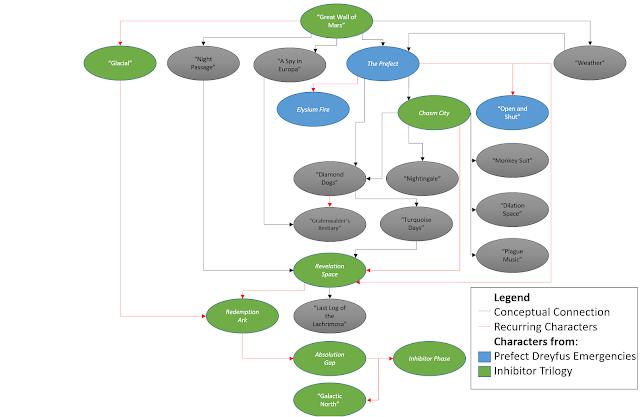
In addition, I came up with a dependency tree for how all the stories interact. I'll post it down here since it has minor spoilers.
Subscribe to:
Posts (Atom)