Friday, August 31, 2012

Do Androids Dream of Electric Sheep?

Around three years ago, I watched the movie Blade Runner.  I know that there are multiple different editions and I could not really tell you which one I watched.  I primarily watched it because it is a classic and stars Harrison Ford, one of my favorite actors.  I knew it was based on a book but I never really got around to picking it up until this summer.

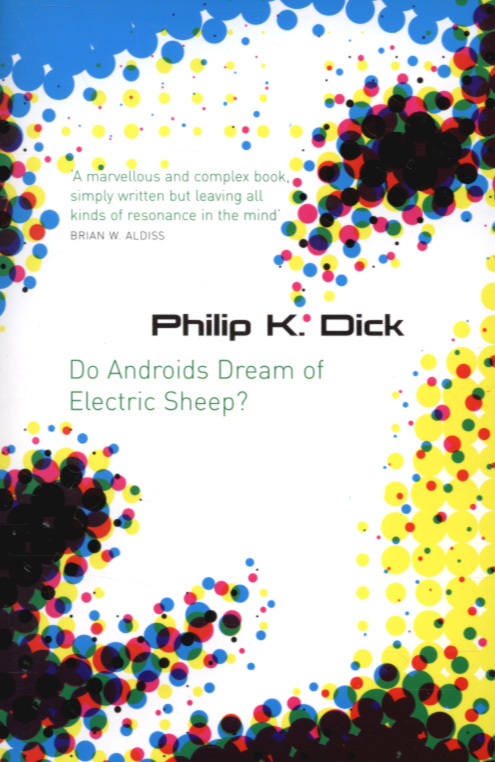
This summer I was in an environment with a lot more used book stores than the town I currently live in and I went a little crazy.  I am unsure of exactly how many books I bought but shipping them home came to about 25 pounds.  I went in one bookstore that had more than 20 copies of Do Androids Dream of Electric Sheep which is the book Blade Runner is based on.  I snatched it up because, well, why not?  (Also, it had an abnormal cover for the book which I always like)

I have to say that I didn't notice this was a sheep until I got the cover for this post.  I just thought it was random blobs of color.  Suddenly, it makes way more sense.


While it has been a while since I have seen the movie, I felt that this book made more sense than the movie overall.  They definitely bring up the question of the difference between humans and replicants in different ways than the movie.  In addition, there is this whole strange religion that the movie basically ignores that allows the author to bring in some other concepts like the battle between entertainment and religion. 

Overall, this book uses its post apocalyptic setting to fit a surprising amount of metaphor, symbolism, and debate into its relatively short story.  There are certainly some parts that are strange, but if the reader can take those in stride, this book will give them a lot to think about.  I would give it an 84%.

Thursday, August 30, 2012

How to Live Safely in a Science Fictional Universe

I think that Charles Yu would have been a better choice to the sixth Hitchhiker's Guide book than Eoin Colfer.  I will admit that I have not read the latest edition to the series, but I have heard from others that it was not fantastic.  Unlike many series, I am perfectly happy to let that one rest as the trilogy in five parts that it was meant to be.

The reason that I think that Charles Yu would have done a better job is that this his book, How to Live Safely in a Science Fictional Universe, is very similar to the later books in the series.  It has that same mixture of being humorous, meaningful, and slightly depressing.


The reason I picked up this book was the words "a novel" on the front.  At first glance I thought it was one of thise faux instruction books like the zombie survival guide.  Lured in by the promise of a real story and not lists of good things to remember if you travel back in time, I gave it a read.

The book is chock full of references to other science fiction works, some blatant some subtle, but all lovingly added.  There is a great section about when he was growing up how all the kids on his block wanted to be Han Solo.  Much of the book takes place in clearly science fictional locales but there is so much about his relationship with his father and his life growing up that I cannot help but wonder if it is at least a little autobiographical. 

This book has so many great quotes, I can almost flip through it and find one on every page.  There is an interesting discussion about the how there are many versions of who a person could be, but only one version of who a person ought to be (in relation to the many worlds theory of time travel).   Another really interesting part is when the author talks about how people, when given access to time travel, will travel back to the worst day of their lives.  I am not sure if I believe that everyone would do that, but I think a great many people would.

This book does have a fair amount of technobabble.  I think it is intended to be humorous, and in some places it is.  However, I feel that it might drive off some less tolerant readers.  Despite this it is overall a fun read.  If you like science fiction, philosophical musings, and humor, you will like this book.  I would give it a 81%.

Monday, August 13, 2012

Shane

My discovery of Shane was sparked by Wikipedia.  I was looking up information on the most recent Dark Tower book (which I will be reviewing soon) and I began wandering through Wikipedia as some people have a tendency to do.  I noticed that main character of the Dark Tower series, Roland, was partially based off of the titular character of the book Shane. I do so love origin stories and behind the scenes information, so I thought it would be worthwhile picking up.

When I did scoop it up at my local used book store, (it came out after 1923, so its copyright is still strong) I noticed that it was very short.  Like my the book I reviewed immediately before this one, it was probably 120 pages at the most.  I had noticed on Amazon that versions of the book had been edited to remove "words that might offend" and so I was a little hesitant to pick up a copy without knowing if it was the edited one or not but after a quick look at the copyright page I saw Bantam was kind enough to promise "It contains the complete text of the original hard-cover edition. NOT ONE WORD HAS BEEN OMITTED."  There were still times when characters said "By Godfrey" or something similar but I assume that that was in the original version.


What I read about this book would have me believe that it redefined the western genre; somewhat created the mysterious gunslinger archetype.  I would believe it, a lot of this book seems slightly cliche now but I can forgive that if it was creating those tropes.  This was Jack Schaefer's first book, and his most famous.  For a writer to come out of the gate with a book like this shows real skill.

The storytelling and pacing are excellent.  Living in this era, knowing that the mysterious gunfighter is the protagonist, most readers would be able to guess a lot of the plot just from that.  However, this story is told entirely from the view of an admiring kid, which does make it an interesting change from the norm.  The way that certain things are described, the book can really take you into the kid's head and show how he really looks up to Shane.

I am not a huge fan of the western genre, but I enjoyed this.  It was a fast, fun read with bona fide historical significance. Overall, I would give it an 87%.

Sunday, August 12, 2012

The Uncommon Reader

When I was at the Connie Willis signing, one of the people in the audience asked her what books she would recommend to readers other than her own.  She suggested many books, several of them classics like Dickens, many of which went in one ear and out the other.  However, one lodged in my sulci and lingered in my thoughts.  She described The Uncommon Reader as a book for people who love books.  She summarized the basic plot as "The queen discovers a library at the kingdom's expense" and mentioned that there were many things in the book that would be almost in jokes to a regular reader.  This sounded like a book that I would like to read someday, so I made a mental note of it and told myself I would pick it up someday.

That very weekend, I saw it staring at me out of the shelves of my favorite new bookstore and, needing something that I would be able to finish in the few days before I was leaving town, scooped it up.  Not even a child would call this a long book, it is 120 pages at the outside, more of a novella than a novel but it delivers upon Ms. Willis' promise.

Anyone who is a voracious reader will easily emphasize with the queen as she reads her way across the kingdom, losing interest in some of the boring pomp and wanting only to talk about books.  Mr. Bennett manages to mention a great deal of writers, some directly and some indirectly, so this book has the quality of being more fleshed out the more you have read.

Near the end of the book, the queen says something really interesting: "Reading softens one while writing toughens one up".  I had never thought about reading and writing in those terms before.  I am not 100% sure I agree with the sentiment but it is certainly food for thought.

If you are someone who likes to read, you will enjoy this book.  If you fit into the preceding category and are well read too, then you will love this book.  Overall, I would give this book an 83% but if you can catch all of the references, which I know I didn't, it is probably more like an 87%.

Monday, July 30, 2012

The Windup Girl

The Windup Girl was an interesting journey in book form.  I was a fair way in before I decided that I liked it.  Immediately after I made that decision, the book killed my favorite character, which threw me back into indecision (not that I hold a grudge for books killing my favorite characters, he just kinda felt like one of the only things the story had story going for it).  However, when I turned the last page, I was disappointed that there wasn't more in the best possible way.  Looking back from the remove of having finished the book, I have to say that it was quite good.

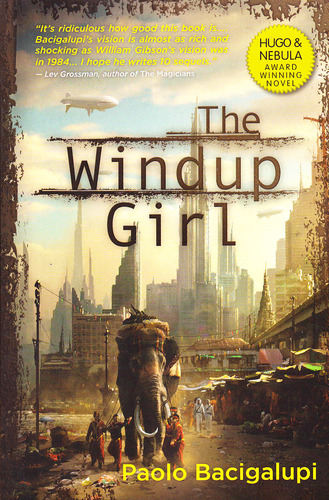
The concept of the book is that in a world where almost all fossil fuels have been exhausted and engineered plagues have ravaged the globe, the most important things are calories and joules.  A place where they have automatic weapons powered by springs and elephants running conveyor belts is interesting indeed, and sort of a troubling look into the future.

This book has excellent concepts from the micro scale to the macro scale, but its weakness is its characters, basically none of whom are likable.  Some of them are interesting, sure, but I did not feel I had any one to root for.  It is interesting to see how a variety of personality types fit into the new world that Mr. Bacigalupi has so vividly imagined.


Overall, it is a good book, with only a few things standing in between it and being a great book.  It is worth reading for the ideas alone.  I would give it an 86%.

Sunday, July 29, 2012

The Prince

machiavellian: suggesting the principles of conduct laid down by Machiavelli; specifically : marked by cunning, duplicity, or bad faith

How many authors get a word based on their name?  Not many, that is for sure. However, poor Machiavelli might have gotten his a little unfairly.  His book The Prince was meant to be an instruction manual for rulers of his time.  It does not really tell the leader to keep bad faith, though I think every leader ends up breaking promises.  Really, the book tells the leader how to be the best possible while still maintaining a ruling position in the country. While having never tried it, I imagine it would be rather effective in medieval Italy.  However, many of his directives would not be so effective in the modern day.

The most famous of these is generally paraphrased as "It is better to be feared than loved".  Machiavelli explains this by saying that fear is more reliable than love because the bonds of fear are stronger than those of love.  But he also points out that either one is preferable to being hated.  (Unlike Yoda, he leaves out the point about fear leading to hatred).  On multiple occasions he references how a prince should not let the women of a conquered country be molested (which is still good advice, mind you).  There are many other tidbits of wisdom as well, however, overall, the book is pretty dry and boring.


As much as it pains me to say it, this is probably not as enjoyable as a higher level summary of the book that makes the effort of relating it to the modern day.  Machiavelli does make a few good points but a lot of it is lost under things that don't pertain to modern reader.

Overall, I would give this book a 60%.

Wednesday, July 25, 2012

Blackout/All Clear

My introduction to Connie Willis was different from many of my introductions to other authors.  Last year, I was in my computer science class waiting for it to start and the professor was making small talk with the students in the front row.  I was, of course, reading.  Suddenly, something caught my ear and I looked up to see the professor on Wikipedia looking a the book Passage by Connie Willis and talking about how much he liked it.  He then went on to look at A Fire Upon the Deep by Vernor Vinge and The Lifecycle of Software Objects by Ted Chiang.  Having read all three by now, I can authoritatively say that all three are good books.

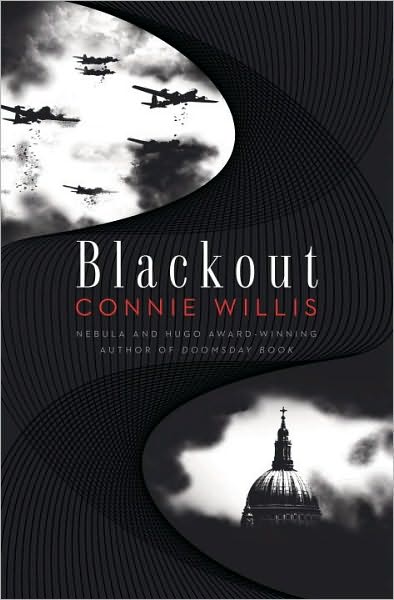
A few weeks ago, I learned that Connie Willis was going to be giving a talk and signing books near where I live.  Since I had enjoyed Passage so much I thought she would be interesting to hear speak and it would be fun to have my book signed by the author.  A few days later, I was in Elliot Bay Books in Seattle (one of the best new book stores I have ever been in) and in their award winning science fiction section they had a Connie Willis book entitled Blackout.  Since I was already going to see her (and already going to spend a good portion of my paycheck at Elliot Bay), I decided to pick it up and try to read it before the signing. 

Upon starting it, I discovered that the book was actually part of a duology, the second part entitled All Clear.  The duology was meant to be one book but, unlike some authors I could name, Connie Willis has some sort of compunction about publishing 1000+ page paperback books.  It seems that the only people who make a distinction between the two books are publisher.  Everyone I have talked to about them, including her, refers to them as "Blackout All Clear".  The two books even read better as one, just pick up All Clear as soon as you finish Blackout.  I cannot imagine waiting in between these. Therefore, I am going against the usual format of reviewing books one at a time and am reviewing this duology as a single entity (that, and I couldn't put them down long enough to write a review about just the first book).

The story, like many stories before it, is about time travel.  The premise is that, in the year 2060 Oxford is sending historians back in time to study the past and report on it.  The story's three main characters are all sent back to England near the beginning of World War II.  It is a fantastic rendition of the war from a British civilians perspective.  However, you do not have to know about WWII to enjoy this book; the characters are marvelous and easy to relate to.

In the vast majority of books that I read, I am able to maintain a steady distance, I suspend my disbelief, but rarely do characters emotional trauma bother me after I put the book down.  This book was the complete opposite of that.  When characters in the book argued it would stress me out, let alone when they were put in life threatening situations.  I found myself crying at the (rather emotional) ending of the series.

I don't want to give away too much of the story, but I have to say that it is, so far, my favorite book of 2012.  There is something in this book for everyone, be they history buffs, sci-fi fans, character lovers, or what have you.  It was clearly painstakingly researched and well thought out.  Having met the author, I can say that she is also an excellent human being and I will be reading more of her books in the future.  When she signed my copies of the books she put little Brittish WWII slogans above the signature; stuff like "Keep calm and carry on" and "Do your bit!"

At the signing, there was also a question and answer session.  I don't remember the question that was asked to provoke this response, but she admitted that she had to rewrite the almost the entire story when she got halfway through because she decided that she had the wrong ending.  When she was signing my books, I asked her what the "wrong ending" would have been and she was gracious enough to tell me.

Overall, I would give this duology a 98%.