Bloggers note: I am deferring my other graphic novel post for a little while but I promise I will come back to it. I liked Lucifer too much to not write about it.
Warning: While this post contains only minor spoilers for Cibola Burn, it does have more major spoilers for Leviathan Wakes, Caliban's War, and Abaddon's Gate, the previous books in the series, simply by virtue of discussing the plot at all.
Right before I started reading The Expanse series they announced that instead of being a three book series, they are making it six books. In between book three (Abbadon's Gate which I reviewed earlier) and this one, they announced that they are making a tv show on Syfy. The show has no release date yet beyond "2015" but news is gradually coming out. Regardless of how well the show does, shortly before this book came out the writers announced that their contract had been extended to 9 books. I think it is safe to say that the series is taking off.
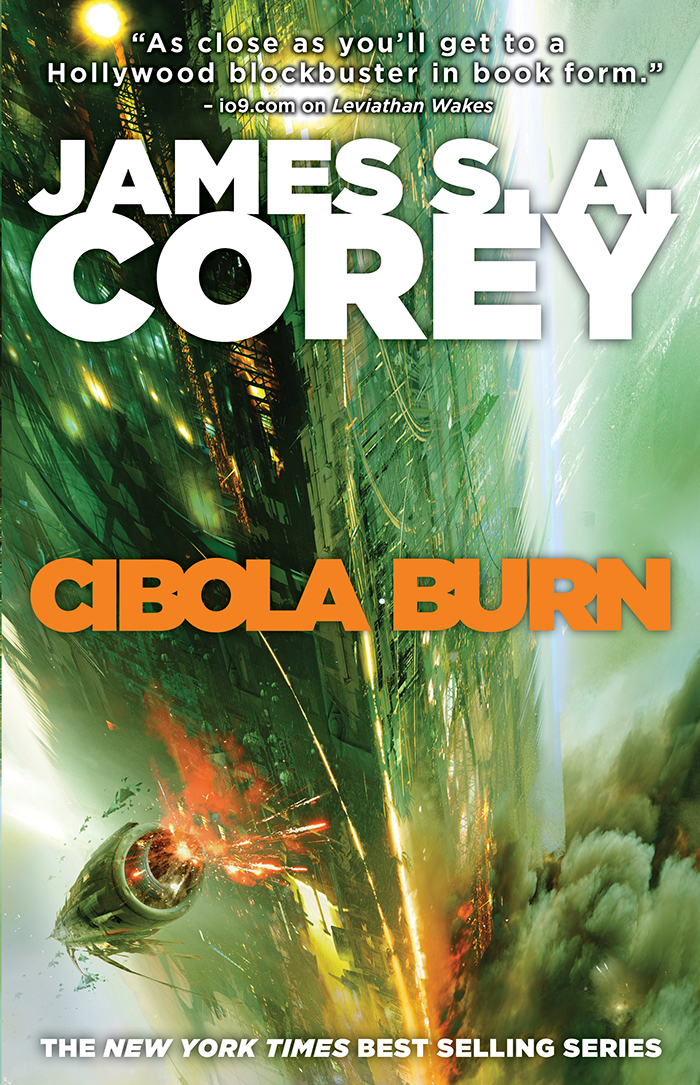
Cibola Burn starts off a little while after the third book leaves off and has some general sci-fi settling an alien planet cliches along with some space western cliches but it blends them well and still has some originality and pushes the overarching plot of the series in an exciting direction. As with the other books in the series, the authors manage to weave another genre in with sci-fi. This time it is clear from early on that the genre is Western and there a lot of plot points that could come directly from a spaghetti western but infused with scifi trappings.
I was privileged enough to get the chance to hear them talk when they were on their book tour (Side note: in case you were confused by my use of plural pronoun, James S. A. Corey is a pseudonym for Daniel Abraham and Ty Franck) and they said that the book was inspired by a game a role playing game that they were playing that was a fusion of Traveller and d20 modern (I was hoped it was inspired by Diaspora, my space RPG of choice) and overall they were very charming and interesting (but then again, I have yet to meet an author whose books I like that I don't like as a person as well).
I think this might be better than the series the other books in the series. It manages to have political intrigue, space combat, and classic western frontier style plottings all blended together. It also repeatedly shows the authors careful tracking of how the events in their story affect their setting as a whole and the political balances within it.
Overall, I would give this book a 96%.
Informal book reviews and general thoughts about books from someone who enjoys reading
OR
Poorly written reviews of well written books
Saturday, August 30, 2014
Wednesday, August 13, 2014
The Sandman
Blogger's note: While I normally write only on the full length prose books that I read, I am taking an exception to write about comic series in this post and the next one then we will back to regularly scheduled programming (until I read another thing that isn't a full length book that I really like).
The Sandman is considered by a lot of people to be the best comic series of all time. I am not sure that I am willing to endorse it that heavily (Y: The Last Man and Lucifer beat it in my mind) but it is certainly good and contains some awesome concepts. The series ran for 75 issues from 1989 to 1996 and spawned numerous spin offs including a miniseries, Overture, which is still running today. I got a collection of short stories set in the universe which piqued my interest and, after ruminating on it for a while, I splurged and bought a nice two volume hard cover collection.
The series is about the seven "Endless," Dream (the titular main character), Destiny, Desire, Despair, Destruction, Delirium, and Death (the last two were my favorites), who are slightly less than gods and represent the concepts that they are named after. The series is a collection of short stories that range from one to twelve issues long involving Dream and other Endless but a lot of the time some normal person will be a main character and it is about how the Endless interact with them.
Most of the stories tie together into later stories in the series and as such they build the world in a subtle and gradual way, which is nice. I just feel like they didn't do enough with the concept and the characters (which I guess just shows why spinoffs are still going). Several of the Endless, especially Death and Delirium, really resonated with me and I wish I could have seen more of those characters and with a quick google search you can see that Death resonated with a lot more people than just me.
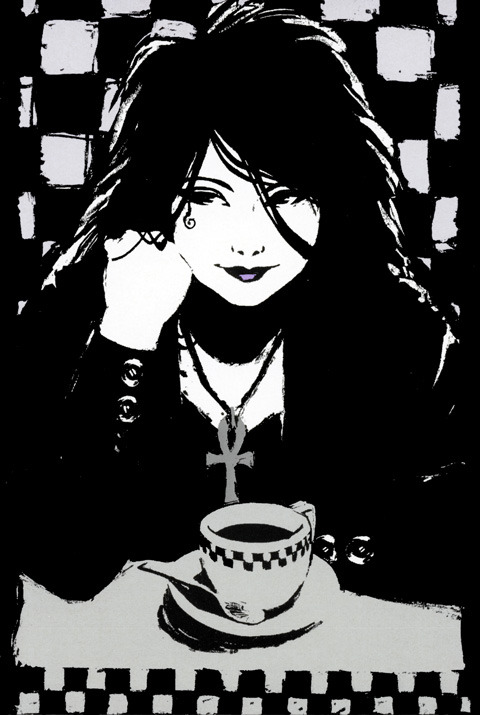
Death is a vaguely gothic looking girl who is almost always smiling. She doesn't smile sadistically but in a friendly, companionable way. I can't describe why I like her better than one of the characters from the series does: "It would be really neat if Death was somebody and not just nothing, or pain, or blackness. And it would be really good if Death could be be somebody like [her]. Somebody funny, and friendly, and nice, And maybe just a tiny bit crazy." So often Death is intimidating, it is refreshing and nice to have a kind Death for once.
Overall, I would give this series a 94%.
P.S.: If this post makes you curious about the series, I recommend you pick up Sandman: Endless Nights. That is what I started on and if you like that you will like the rest of the series.
P.P.S.: While some people disagree with me, I am of the impression that the last issue of the series is out of place and takes away some of the impact from the end. If you are reading the series I recommend that you read issue #75 in between issues 56 and 57 and end the series on 74. While there are some aspects of 75 that make it a suitable ending, there are a lot more that are not.
The Sandman is considered by a lot of people to be the best comic series of all time. I am not sure that I am willing to endorse it that heavily (Y: The Last Man and Lucifer beat it in my mind) but it is certainly good and contains some awesome concepts. The series ran for 75 issues from 1989 to 1996 and spawned numerous spin offs including a miniseries, Overture, which is still running today. I got a collection of short stories set in the universe which piqued my interest and, after ruminating on it for a while, I splurged and bought a nice two volume hard cover collection.
This picture can't really do them justice but each of these books is more than 1000 full color pages of comics. I have never had a comic book this large before and when you don't have to stop for issue breaks it really helps get the feeling that is one contiguous story... or that would be the case if it was one contiguous story.
The series is about the seven "Endless," Dream (the titular main character), Destiny, Desire, Despair, Destruction, Delirium, and Death (the last two were my favorites), who are slightly less than gods and represent the concepts that they are named after. The series is a collection of short stories that range from one to twelve issues long involving Dream and other Endless but a lot of the time some normal person will be a main character and it is about how the Endless interact with them.
Most of the stories tie together into later stories in the series and as such they build the world in a subtle and gradual way, which is nice. I just feel like they didn't do enough with the concept and the characters (which I guess just shows why spinoffs are still going). Several of the Endless, especially Death and Delirium, really resonated with me and I wish I could have seen more of those characters and with a quick google search you can see that Death resonated with a lot more people than just me.
Death is a vaguely gothic looking girl who is almost always smiling. She doesn't smile sadistically but in a friendly, companionable way. I can't describe why I like her better than one of the characters from the series does: "It would be really neat if Death was somebody and not just nothing, or pain, or blackness. And it would be really good if Death could be be somebody like [her]. Somebody funny, and friendly, and nice, And maybe just a tiny bit crazy." So often Death is intimidating, it is refreshing and nice to have a kind Death for once.
Overall, I would give this series a 94%.
P.S.: If this post makes you curious about the series, I recommend you pick up Sandman: Endless Nights. That is what I started on and if you like that you will like the rest of the series.
P.P.S.: While some people disagree with me, I am of the impression that the last issue of the series is out of place and takes away some of the impact from the end. If you are reading the series I recommend that you read issue #75 in between issues 56 and 57 and end the series on 74. While there are some aspects of 75 that make it a suitable ending, there are a lot more that are not.
Saturday, July 26, 2014
Idoru
My only other experience with William Gibson was his most
famous book, Neuromancer. I enjoyed it but I read it directly after Snow Crash which was my introduction to
Neal Stephenson, one of my favorite authors.
Following that, even a great book would feel a little lackluster.
I had heard interesting things about Idoru so I picked it up when I saw it for sale at my local
bookstore. Considering my last
experience with William Gibson, this book is surprisingly similar to Snow Crash (though still very
different). It was written in 1996 so
while it was speculative, it was close enough to the present to get a lot of
things right.
The book is set in the near future and the plot is about a celebrity
who decides to marry a digital being (the idoru of the title). The various people this affects, from his fan
club to his entourage get caught up in a lot of intrigue and it is an
interesting commentary on celebrity culture and some discussion of the future
of the internet and fame and romance.
I think the part of the book that I will remember the best
is the concept of nodal points. It is
the concept that giant mass of data people generate move in certain patterns
around certain points that make it possible to predict large things that are
not part of the data. Now this less exciting
with machine learning like when Target advertising determined a teen was pregnant before she told her parents
but the concept of a human being able to know what to look for and be able to intuit
things like that is interesting. The author says that he based it off of his
own ability so it is, seemingly, possible.
At the time I was reading it, I didn’t realize it was part
of a trilogy (and the middle book no less!) I really didn’t feel that it was
missing in backstory or conclusions, which are both valid concerns for the
middle book of a trilogy so I am happy to say that this one can stand alone,
though I would have preferred to read it in its proper place.
Overall, I would give this book an 87%.
Sunday, June 22, 2014
You Can Date When You're Forty
My first exposure to Dave Barry was my father reading me his columns out of the paper. The style of humor in the columns would have us both in hysterics and I have been a fan ever since. My dad had a couple Dave Barry books, which I devoured as I aged and I loved his year in review columns. His just shy of absurdist sense of humor tickles my funny bone in just the right places. When I saw he was doing a book reading and signing where I live, I jumped at the chance to see him.
At the reading he did some stand up comedy (some particularly biting bits about Miami) as well as reading from his book. Afterwards at the signing, he showed himself to be a very nice man, not at all brusque like some authors are at signings, he seemed like he genuinely wanted to be there and talk with his fans, young and old.
The book contains a collection of stories that had me laughing all the way through. While the title and subtitle imply that it is about parenting, there are a lot of other topics contained within the book Some examples include Israel, Bieber, and air travel. The format is just a collection of longer than normal Dave Barry articles which have a vague thematic direction towards parenting. The book is not that long but it is chocked full of laughs. This would be a great choice to pull down on your eReader of choice to read on vacation.
The part that I will probably remember the most about this book is that I was reading the chapter about Israel at the same time that one of my friends was visiting Israel and Dave Barry and my friend did a lot of the same things (his version of events was funnier than hers).
Overall, I would give this book a 90%.
At the reading he did some stand up comedy (some particularly biting bits about Miami) as well as reading from his book. Afterwards at the signing, he showed himself to be a very nice man, not at all brusque like some authors are at signings, he seemed like he genuinely wanted to be there and talk with his fans, young and old.
The book contains a collection of stories that had me laughing all the way through. While the title and subtitle imply that it is about parenting, there are a lot of other topics contained within the book Some examples include Israel, Bieber, and air travel. The format is just a collection of longer than normal Dave Barry articles which have a vague thematic direction towards parenting. The book is not that long but it is chocked full of laughs. This would be a great choice to pull down on your eReader of choice to read on vacation.
The part that I will probably remember the most about this book is that I was reading the chapter about Israel at the same time that one of my friends was visiting Israel and Dave Barry and my friend did a lot of the same things (his version of events was funnier than hers).
Overall, I would give this book a 90%.
Saturday, May 3, 2014
Sweet Thursday
I received a John Steinbeck collection as a Christmas gift a few years ago and I enjoyed it, having never read anything by him before. It had most of the popular Steinbeck stories such as "Of Mice and Men" and "Tortilla Flat" (though it is missing "The Grapes of Wrath"). It ends with the longer story "Cannery Row" which is about the interweaving lives of large cast of characters in Monterey, California. When I was writing about the collection on here, I was doing a little research on the stories and saw that "Cannery Row" had a sequel called Sweet Thursday. I picked up a while ago and finally got around to reading it.
Sweet Thursday picks up a while after "Cannery Row" and has only a few characters that overlap however, the primary protagonists of the previous story, Doc and Mack return and again the main characters. The book focuses mostly on the personal journey of Doc and how he is trying to rouse himself out of a depression and his friends actions to help him. As you may be able to guess if you have read "Cannery Row" this leads to a lot of entertaining antics.
This is a sequel but it is set far enough off that it could be its own story. If you read it that way the characters might lose a little depth but would still be fine. I think that "Cannery Row" is a better overall story though so I would recommend starting with that regardless. Like its predecessor, Sweet Thursday also manages to end with some semblance of a happy ending which is pretty rare in Steinbeck.
I think the part of this book that I will remember the most is Fauna, the woman who runs the local brothel. She genuinely cares for her charges and really wants them to be happy. She really sort of makes the book complete, if a tad manipulative.
Overall, I would give this book an 87%.
This is a sequel but it is set far enough off that it could be its own story. If you read it that way the characters might lose a little depth but would still be fine. I think that "Cannery Row" is a better overall story though so I would recommend starting with that regardless. Like its predecessor, Sweet Thursday also manages to end with some semblance of a happy ending which is pretty rare in Steinbeck.
I think the part of this book that I will remember the most is Fauna, the woman who runs the local brothel. She genuinely cares for her charges and really wants them to be happy. She really sort of makes the book complete, if a tad manipulative.
Overall, I would give this book an 87%.
Friday, April 18, 2014
Hard-Boiled Wonderland and the End of the World
The first (and only before this) Murakami book I read was 1Q84. It was not a great book. It had a lot of unresolved questions at the end and yet also spent a lot of time on things that didn't really matter. It was a good 400 page book hiding in the midst of 1100 pages. Then someone recommended Hard-Boiled Wonderland and the End of the World to me. The title sounded interesting and I thought that I could give Murakami one more go. Boy, am I glad I did.
The book has the unique trait of being almost two books in one. The odd chapters are in "Hard-Boiled Wonderland" and the even numbered chapters are at "The End of the World." It is not even clear at first how the two stories are related or even if they are at all. But the two stories are different even in tone so it really feels like you could be reading two different books.
I read that Hard-Boiled Wonderland was slightly inspired by Raymond Chandler and I can definitely see that. I am a fan of that style of fiction (though I have read more Dashiell Hammett and The Thin Man is great) but this takes it and mixes it with a sort of semi-futuristic experience. Also, unlike those stories, it isn't as much about detective work as it just is sort of the tone of the story is similar to those types of books.
The End of The World, on the other hand, is a subdued, slightly fantastical story. It has several interesting concepts but there is a lot of symbolism that ties into the other story which really is probably the most interesting part.
This book has a lot of the problems that 1Q84 had: seemingly random pointless details and plot threads that don't go anywhere but this book handles it a lot better. Possibly because it didn't have 1000 pages to get my hopes up that some of them were going places. In this book they were slight defects, in 1Q84 they were borderline deal breakers.
I think that the part of this book that will stay with me the longest after I have read it is its discussion of consciousness and the unconscious mind and how they interact. At the end of the book there are some great points to think on (that I would not dare to spoil here). Suffice to say, I quite liked this book.
Overall, I would give this book a 96%.
Monday, April 7, 2014
The Man in the High Castle
After reading and enjoying Do Androids Dream of Electric Sheep, I knew I wanted to read more Phillip K. Dick. I read that The Man in the High Castle was an interesting alternate history story and, without seeing anything else about it, decided to pick it up. It turns out to be an alternate history where the Axis wins World War II and divides up America between Germany and Japan.
The book follows several characters around as they try to live in this world. They are related but the storylines do not really intersect to come to a climax, it is more like we just see several people's stories that flesh out the world. The story focuses generally on people trying to continue to live with their American ideals even a world where those are belittled and unvalued.
The racism in this book is so intense that it actually bothered me to read. The way that the culture treated basically every non-Aryan, non-Japanese person caused me a moderate amount of stress while reading. The fact that people could be that horrible to one another, and these people weren't even the villians of the story, just casual people off the street, is amazing and not in a positive way. History was rough, but this clearly shows it could have been rougher.
Almost every character in this book consults the I Ching which I am not exceedingly familiar with but my understanding is that it is a fortune telling device like tarot cards. The way that the people tend to read whatever they want into it seems like a minor critique of fortune tellers while at the same time showing how much America has changed from the one of the real world 60's.
I think the part that will stick with me the longest is a quote towards the end of this book: “We do not have the ideal world, such as we would like, where morality is easy because cognition is easy. Where one can do right with no effort because he can detect the obvious.” The quote has an interesting sentiment and I like the concept that doing good is hard but it is worth doing anyway.
Overall, I would give this book a 92%.
Subscribe to:
Posts (Atom)