My first exposure to Dave Barry was my father reading me his columns out of the paper. The style of humor in the columns would have us both in hysterics and I have been a fan ever since. My dad had a couple Dave Barry books, which I devoured as I aged and I loved his year in review columns. His just shy of absurdist sense of humor tickles my funny bone in just the right places. When I saw he was doing a book reading and signing where I live, I jumped at the chance to see him.
At the reading he did some stand up comedy (some particularly biting bits about Miami) as well as reading from his book. Afterwards at the signing, he showed himself to be a very nice man, not at all brusque like some authors are at signings, he seemed like he genuinely wanted to be there and talk with his fans, young and old.
The book contains a collection of stories that had me laughing all the way through. While the title and subtitle imply that it is about parenting, there are a lot of other topics contained within the book Some examples include Israel, Bieber, and air travel. The format is just a collection of longer than normal Dave Barry articles which have a vague thematic direction towards parenting. The book is not that long but it is chocked full of laughs. This would be a great choice to pull down on your eReader of choice to read on vacation.
The part that I will probably remember the most about this book is that I was reading the chapter about Israel at the same time that one of my friends was visiting Israel and Dave Barry and my friend did a lot of the same things (his version of events was funnier than hers).
Overall, I would give this book a 90%.
Informal book reviews and general thoughts about books from someone who enjoys reading
OR
Poorly written reviews of well written books
Sunday, June 22, 2014
Saturday, May 3, 2014
Sweet Thursday
I received a John Steinbeck collection as a Christmas gift a few years ago and I enjoyed it, having never read anything by him before. It had most of the popular Steinbeck stories such as "Of Mice and Men" and "Tortilla Flat" (though it is missing "The Grapes of Wrath"). It ends with the longer story "Cannery Row" which is about the interweaving lives of large cast of characters in Monterey, California. When I was writing about the collection on here, I was doing a little research on the stories and saw that "Cannery Row" had a sequel called Sweet Thursday. I picked up a while ago and finally got around to reading it.
Sweet Thursday picks up a while after "Cannery Row" and has only a few characters that overlap however, the primary protagonists of the previous story, Doc and Mack return and again the main characters. The book focuses mostly on the personal journey of Doc and how he is trying to rouse himself out of a depression and his friends actions to help him. As you may be able to guess if you have read "Cannery Row" this leads to a lot of entertaining antics.
This is a sequel but it is set far enough off that it could be its own story. If you read it that way the characters might lose a little depth but would still be fine. I think that "Cannery Row" is a better overall story though so I would recommend starting with that regardless. Like its predecessor, Sweet Thursday also manages to end with some semblance of a happy ending which is pretty rare in Steinbeck.
I think the part of this book that I will remember the most is Fauna, the woman who runs the local brothel. She genuinely cares for her charges and really wants them to be happy. She really sort of makes the book complete, if a tad manipulative.
Overall, I would give this book an 87%.
This is a sequel but it is set far enough off that it could be its own story. If you read it that way the characters might lose a little depth but would still be fine. I think that "Cannery Row" is a better overall story though so I would recommend starting with that regardless. Like its predecessor, Sweet Thursday also manages to end with some semblance of a happy ending which is pretty rare in Steinbeck.
I think the part of this book that I will remember the most is Fauna, the woman who runs the local brothel. She genuinely cares for her charges and really wants them to be happy. She really sort of makes the book complete, if a tad manipulative.
Overall, I would give this book an 87%.
Friday, April 18, 2014
Hard-Boiled Wonderland and the End of the World
The first (and only before this) Murakami book I read was 1Q84. It was not a great book. It had a lot of unresolved questions at the end and yet also spent a lot of time on things that didn't really matter. It was a good 400 page book hiding in the midst of 1100 pages. Then someone recommended Hard-Boiled Wonderland and the End of the World to me. The title sounded interesting and I thought that I could give Murakami one more go. Boy, am I glad I did.
The book has the unique trait of being almost two books in one. The odd chapters are in "Hard-Boiled Wonderland" and the even numbered chapters are at "The End of the World." It is not even clear at first how the two stories are related or even if they are at all. But the two stories are different even in tone so it really feels like you could be reading two different books.
I read that Hard-Boiled Wonderland was slightly inspired by Raymond Chandler and I can definitely see that. I am a fan of that style of fiction (though I have read more Dashiell Hammett and The Thin Man is great) but this takes it and mixes it with a sort of semi-futuristic experience. Also, unlike those stories, it isn't as much about detective work as it just is sort of the tone of the story is similar to those types of books.
The End of The World, on the other hand, is a subdued, slightly fantastical story. It has several interesting concepts but there is a lot of symbolism that ties into the other story which really is probably the most interesting part.
This book has a lot of the problems that 1Q84 had: seemingly random pointless details and plot threads that don't go anywhere but this book handles it a lot better. Possibly because it didn't have 1000 pages to get my hopes up that some of them were going places. In this book they were slight defects, in 1Q84 they were borderline deal breakers.
I think that the part of this book that will stay with me the longest after I have read it is its discussion of consciousness and the unconscious mind and how they interact. At the end of the book there are some great points to think on (that I would not dare to spoil here). Suffice to say, I quite liked this book.
Overall, I would give this book a 96%.
Monday, April 7, 2014
The Man in the High Castle
After reading and enjoying Do Androids Dream of Electric Sheep, I knew I wanted to read more Phillip K. Dick. I read that The Man in the High Castle was an interesting alternate history story and, without seeing anything else about it, decided to pick it up. It turns out to be an alternate history where the Axis wins World War II and divides up America between Germany and Japan.
The book follows several characters around as they try to live in this world. They are related but the storylines do not really intersect to come to a climax, it is more like we just see several people's stories that flesh out the world. The story focuses generally on people trying to continue to live with their American ideals even a world where those are belittled and unvalued.
The racism in this book is so intense that it actually bothered me to read. The way that the culture treated basically every non-Aryan, non-Japanese person caused me a moderate amount of stress while reading. The fact that people could be that horrible to one another, and these people weren't even the villians of the story, just casual people off the street, is amazing and not in a positive way. History was rough, but this clearly shows it could have been rougher.
Almost every character in this book consults the I Ching which I am not exceedingly familiar with but my understanding is that it is a fortune telling device like tarot cards. The way that the people tend to read whatever they want into it seems like a minor critique of fortune tellers while at the same time showing how much America has changed from the one of the real world 60's.
I think the part that will stick with me the longest is a quote towards the end of this book: “We do not have the ideal world, such as we would like, where morality is easy because cognition is easy. Where one can do right with no effort because he can detect the obvious.” The quote has an interesting sentiment and I like the concept that doing good is hard but it is worth doing anyway.
Overall, I would give this book a 92%.
Saturday, March 22, 2014
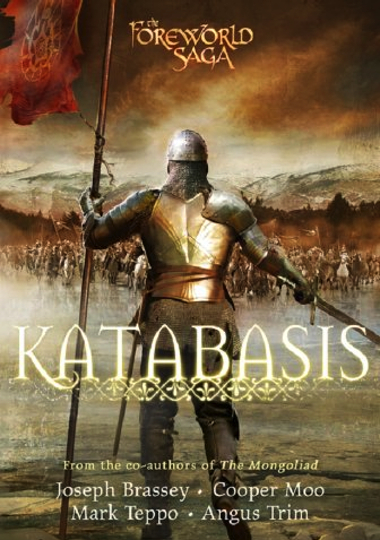
Katabasis & Siege Perilous
At the end of the first three Mongoliad books, the main plot has been resolved but there are a few and fertile ground for imagining what happens next to the surviving characters (spoilers: some people die). The following two books, for the most part, answer those questions though not always satisfactorily. Also, I was partially through the fourth book when I realized that they had lost Neal Stephenson and Greg Bear as authors and the fifth book is only by one author (E. D. deBirmingham) and not even a collaboration like the other four.
Katabasis, the fourth book, wraps up the story of the shield brethren (yes, there are shield brethren in the 5th book but they are not the focus). There are definitely some great battles and fight scenes, which was what originally drew me into the first Mongoliad book, this one seems somewhat lacking in the epic scope of the first three. Also, it was primary about infighting between various factions of the western world and it made all the efforts of the previous books to force the mongols back seem a little pointless (however, I am sure that they did meticulous historical research and this resembles what happened in the period).
At the end of the big battle one of the characters gives a speech that I won't post here because it contains minor spoilers but it is a good speech and concludes with the line "Let us live my friends, and by living keep alive our hope for a world made better by our presence in it." I particularly liked that line.
Siege Perilous provides (more of) a conclusion to the Rome plot lines in books 2 and 3 which were basically ignored in Katabasis. The story is based on the siege of the Cathars in France but, as always, our protagonists make an appearance. Once again, there was some good combat but most of it was seen from the viewpoints of people not directly involved. However, from a historical perspective this one felt more interesting than the other, perhaps because I knew a little about the siege before I read the book. Probably the most annoying part of the story was the end where they resolve one plot point by saying, almost literally, "That is a story for someone else."
Both of these trend towards a more fantastical story than the historical fiction that originally interested me. I have it difficult to believe that there were various magic elements permeating history it breaks my suspension of disbelief every time an, generally subtle, implication of magic occurs. They are definitely a continuation in the spirit of the first three books but I don't think that they really needed a direct continuation.
Overall, I would give these two together an 82%.
Katabasis, the fourth book, wraps up the story of the shield brethren (yes, there are shield brethren in the 5th book but they are not the focus). There are definitely some great battles and fight scenes, which was what originally drew me into the first Mongoliad book, this one seems somewhat lacking in the epic scope of the first three. Also, it was primary about infighting between various factions of the western world and it made all the efforts of the previous books to force the mongols back seem a little pointless (however, I am sure that they did meticulous historical research and this resembles what happened in the period).
At the end of the big battle one of the characters gives a speech that I won't post here because it contains minor spoilers but it is a good speech and concludes with the line "Let us live my friends, and by living keep alive our hope for a world made better by our presence in it." I particularly liked that line.
Siege Perilous provides (more of) a conclusion to the Rome plot lines in books 2 and 3 which were basically ignored in Katabasis. The story is based on the siege of the Cathars in France but, as always, our protagonists make an appearance. Once again, there was some good combat but most of it was seen from the viewpoints of people not directly involved. However, from a historical perspective this one felt more interesting than the other, perhaps because I knew a little about the siege before I read the book. Probably the most annoying part of the story was the end where they resolve one plot point by saying, almost literally, "That is a story for someone else."
Both of these trend towards a more fantastical story than the historical fiction that originally interested me. I have it difficult to believe that there were various magic elements permeating history it breaks my suspension of disbelief every time an, generally subtle, implication of magic occurs. They are definitely a continuation in the spirit of the first three books but I don't think that they really needed a direct continuation.
Overall, I would give these two together an 82%.
Saturday, March 8, 2014
The Princess Bride
I am, as you may have guessed from the books I read, a big fan of The Princess Bride the movie. The blend of romance and action and witticisms are highly entertaining. I could fill an entire blog post with things I love from that movie. I think my first introduction to it was at a Star Wars convention where Nick Gillard, the choreographer for all the lightsaber fights in the prequels (whatever you say about the prequels, it is hard to complain about the lightsaber fights), said that the fight between the man in black and Inigo Montoya was his favorite fight in cinema. I filed this factoid away and, when I finally saw the movie, did enjoy the fight and the rest of the film.
However, this is not review of the movie, this is a review of the book, which came before the movie. Unlike many movie adaptations of novels, the author actually worked on the screenplay of the movie as well. This gives the novel and the movie the same tone even if the content is not identical. The novel is perhaps even funnier than the movie, there are some great parts in the introduction of Buttercup that had me chuckling out loud.
Overall, I would give this book a 95%.
However, this is not review of the movie, this is a review of the book, which came before the movie. Unlike many movie adaptations of novels, the author actually worked on the screenplay of the movie as well. This gives the novel and the movie the same tone even if the content is not identical. The novel is perhaps even funnier than the movie, there are some great parts in the introduction of Buttercup that had me chuckling out loud.
You will notice that on the cover of the novel it says "S. Morgenstern's Classic Tale of True Love and High Adventure". For reasons unknown to me, Goldman has decided to write the novel as if he was abridging someone else's work. This allows him to insert funny interjections into his own writing and "skip over" sections. It makes for some entertaining parts even if it is a confusing tack to take.
But he takes it further than that, in the introductions, he talks about travelling to Florin as if it is a real place and he discusses conversations with the owners of the Morgenstern estate over imaginary legal issues with abridging the book. Stephen King (with all his ties to Florin) even makes a cameo. However, the real overarching story of the introductions and forewords is Goldman's relationship with his own family and, due to the way the introductions are ordered with newest first, it is like peeling back layers of onion to see how he got to where he is today. I don't know how much of the story in the introductions is real (Wikipedia tells me that very little of it is) but it is certainly an interesting story.
My one major complaint in this book is the portrayal of Buttercup, she is shown as pretty much helpless for much of the movie, relying on the men in her life to rescue her and save her from all of the perils. I know that this is a cliche of this type of story but this takes it a step to far where, when the reader sees something from Buttercup's point of view, it is pointed out that she is bad at math and so cannot give the reader an accurate count of something. That was irksome.
In short, this book is a somewhat unique literary construct and very enjoyable. Anyone who like light-hearted fantasy should probably give it a read (and if you liked the movie, you should definitely read it).
Overall, I would give this book a 95%.
Saturday, February 15, 2014
To Be or Not To Be
Following my last post about Hyperbole and a Half coincidentally this next post is also an "internet book". Ryan North writes one of my favorite webcomics, the creatively named "Dinosaur Comics". If you have never read them I must recommend that you give them a try. Ryan North decided to start a kickstarter funded, choose-your-own-adventure book based on the story of Hamlet. The project blew up and broke multiple kickstarter records. Due to the level of funding the book was able to get artwork for every ending from webcomic artists as well as a prequel story and several other additional features.
This book clocks in at 700 pages, so if you don't like it, it makes quite the doorstop. However, I enjoyed this book immensely. The book is lighthearted and witty but at the same time has great respect for the original work.
Also, this is the first book that I have review here that I haven't finished, if finished means having read every page. I have reached an end multiple, multiple times but I still haven't hit every single possible page or even every single ending. Some of the endings I have reached were the original ending (of course), one where ghost Hamlet and his ghost dad lead a ghost army to fight ghost aliens, and one where Hamlet and Ophelia invent thermometers and live happily ever after. These are just a few of the many endings that book has to offer.
The book also allows you to play as Hamlet, Ophelia, and Hamlet's father and each of these stories has its own set of endings and experiences and sometimes switches back and forth between them. In certain read throughs, you can play as Claudius reading a choose-your-own-adventure book. It is very entertaining. It is clear that the better that you know the source material the more enjoyable the book is. However, the book starts at a high level of enjoyment even without any knowledge of the source material.
I think my favorite part of the book is a particular part where Hamlet fights pirates and all of the choices in that section are choosing between the witticisms Hamlet uses in the fight. While it is a little graphic, that section alone is worth pages and pages of giggles.
Overall, I would give this book a 94%.
This book clocks in at 700 pages, so if you don't like it, it makes quite the doorstop. However, I enjoyed this book immensely. The book is lighthearted and witty but at the same time has great respect for the original work.
Also, this is the first book that I have review here that I haven't finished, if finished means having read every page. I have reached an end multiple, multiple times but I still haven't hit every single possible page or even every single ending. Some of the endings I have reached were the original ending (of course), one where ghost Hamlet and his ghost dad lead a ghost army to fight ghost aliens, and one where Hamlet and Ophelia invent thermometers and live happily ever after. These are just a few of the many endings that book has to offer.
The book also allows you to play as Hamlet, Ophelia, and Hamlet's father and each of these stories has its own set of endings and experiences and sometimes switches back and forth between them. In certain read throughs, you can play as Claudius reading a choose-your-own-adventure book. It is very entertaining. It is clear that the better that you know the source material the more enjoyable the book is. However, the book starts at a high level of enjoyment even without any knowledge of the source material.
I think my favorite part of the book is a particular part where Hamlet fights pirates and all of the choices in that section are choosing between the witticisms Hamlet uses in the fight. While it is a little graphic, that section alone is worth pages and pages of giggles.
Overall, I would give this book a 94%.
Subscribe to:
Posts (Atom)