Tuesday, April 30, 2013

The Art of Game Design: A Book of Lenses

I generally don't put reviews of my college textbooks.  There are a couple of reasons for this but the primary on is that I rarely read them cover to cover.  This one was an exception, not because I read it out of choice but for class we literally had to read the entire thing.  The class that I read it for was Game Design, not my favorite class but I assume the goal of the class was to give us an overview of what it is like to make a game without going to far in depth.


The author is someone who has a lot of experience in the industry, having made several games including Toontown and the Pirates of the Caribbean ride at Disney.  With this real world experience, he takes a tour through the high level way that games are made.  Over the course of the book, he covers everything from level design to characters to even a working definition of fun.

The subtitle of the book, A Book of Lenses, comes from the sidenotes in the book which he calls lenses.  Each of these sidenotes contains some questions that are designed to make the reader think about the game that they are making.  Some of these are useful but a lot of them seem a little pedantic.

As someone who has taken a lot of Computer Science classes, a significant part of the book was lower level than I needed and could be basically brushed off.  In addition, as someone who has read quite a lot, most of the discussion of story was also pretty unnecessary. As someone who has taken several courses that talk about how to interact with people, the sections on interpersonal relations were also not super useful.

The way that this book is written makes it sound like the author is talking to the reader who is planning to make a game themselves.  I will admit that I am not really interested in making games for a career but I do play quite a few games.  The problem with this is that there is no way for the reader to make a game using anything close to only this book.  All of the discussions are at too high a level of abstraction to really be useful.

I think where this book might be nice is if, on a team building a game, the members read the sections about the parts that they were not working on to get a better understanding of the team as a whole.  This is not to say I did not find some useful gems in here, but in total, it was not particularly useful.

Overall, I would give this book a 76%.

Thursday, April 25, 2013

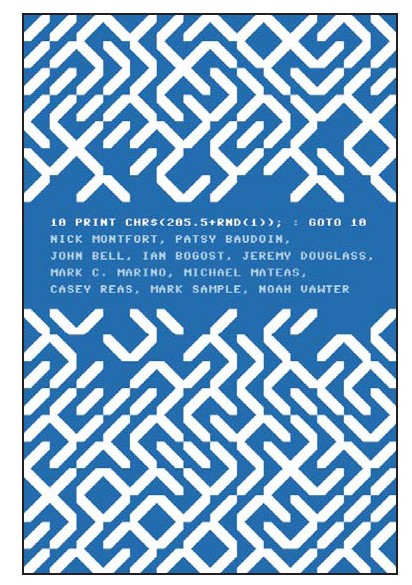
10 PRINT CHR$(205.5+RND(1)); : GOTO 10

Before my Game Design class went completely downhill, the professor recommended this book to us.  She said that it had an interesting relation to one of the programs that we were learning and commented on the development on games.  If the book had cost any money, I probably would have passed but it was free from MIT Press, so I downloaded it and decided to read it eventually.
 
The book is named after a one line program in BASIC, an older programing language.  The program fills up the screen with a random maze and keeps running until the user exits the program.  The program contains several elements that are frowned upon in modern day programming practices but that is neither here nor there.

This book has a really interesting structure.  It takes 10 PRINT (the shortened version of the titular program) and analyzes that in great, painstaking detail.  Then the book spirals outward from there. In its spiral, it touches a variety of topics ranging from mazes to the history of the Commodore 64.

While this book was pretty interesting to me, I feel it would be significantly less so to someone who did not major in Computer Science.  While it covers many things that certainly do not require a computer science degree to comprehend, my eyes glazed over during some of the discussions of porting 10 PRINT to other platforms.

An interesting note about the book, all of the authors collaborated on it, wiki style.  I did not really notice any drastic changes in voice or writing style while I was reading, but the book is pretty short.  A longer book may have made those issues more apparent.

Overall, I would give this book an 86%.

Monday, April 22, 2013

Jonathan Strange and Mr. Norrell

"Can a magician kill a man by magic?" Lord Wellington asked Strange. Strange frowned. He seemed to dislike the question. "I suppose a magician might," he admitted, "but a gentleman never could."

I think that this quote sums up a lot of Susanna Clarke's Jonathan Strange and Mr. Norrell.  This book takes place in an alternate history of Europe and the world where magic is real.  The book takes place in the early 1800's and covers a long period of time.  However, unlike Michael Stackpole's Crown Colonies, real historical events like Waterloo take place throughout the course of the story and all of the geography is real. 


The way that magic works in this book is interesting because it appears to happen basically without cost. Magicians never seem to suffer any sort of consequences for doing even powerful magic.  This makes the magic in this book, in a way more subtle, while also making it more powerful.

This book is Ms. Clarke's debut novel and it is, especially for a debut, quite good.  The book is very long but it uses that length to fully immerse the reader in the world.  The world of the upper class in the early 1800's is very different than the modern world but after a book this long it seems very natural.

The book is also very silly.  At no point is it outright funny, but the author makes a lot of little side comments that make it sillier.  Also, she has built up an entire world of stories and literature that are referenced in her extensive footnotes throughout the book.

While the first third of the book barely has Jonathan Strange in it, he dominates the latter two thirds.  At the end of the book it talks about how some people support Norrell's views and others, Strange's.  However, with Strange taking up so much of the book, it was hard for me to see how people would take Norrell's side of view.  I would say the situation would be analogous to someone who only read Al Franken thinking about Republicans.

I tend to avoid talking about the format that the books I read are in.  However, this book was the first book I read with the new Kindle firmware that estimates the amount of time that the reader has left in chapters and in the book.  I felt like the estimates were a little off but, on the Kindle, it was a nice compromise for the lack of physical pages.

Overall, I would give this book a 94%.

Wednesday, April 10, 2013

11/22/63

I first heard about 11/22/63 from an interview with Stephen King at the end of one of the first Gunslinger comics (I know, I am a nerd).  I do not remember exactly what the question was but it was something about other ideas for comic stories and he described a story about someone who goes back in time to save JFK and comes back to the present to find it ruined and he then has to go back in time again to stop himself from saving JFK.  This concept intrigued me and when I saw that he had made a book based on it, I told myself that I would read it when I got the chance. 

Without giving too much away, I will say that the plot of 11/22/63 does not follow that original idea very closely.  Despite this I greatly enjoyed the book.  The way that it handled time travel was relatively unique and historical detail was great.  The book did lose its way a little in the middle, but it finished strong and was certainly an enjoyable read.


The way that time travel works in this book is interesting and different from any other version of time travel I can think of having seen.  In this there is one time portal that always goes back to exactly the same time and people always come out two minutes after they go in.  The author avoids the problem of all the time travellers running into each other right outside the portal by having the world undergo a reset each time.  Therefore any change that is important has to be the last time the portal is ever used.

The afterword implies that Stephen King has gone a boatload of research for this book, and it shows.  The level of historical detail that he put in is sometimes staggering.  It is easy to believe that the characters are in the 50's and 60's because the author puts in so much effort to make the elements of story really seem like it.

The middle of the book seemed to get a little off message.  The portal opens in 1958 and the reason for not just compacting the story by a year seems unclear.  I feel like the whole plot makes sense if there is one less year for it to happen in but I am sure that Stephen King had his reasons.  Despite this, when the book nears its climax, it becomes almost impossible to put down  The sense of urgency is fantastically done. 

It is interesting to compare this to Blackout/All Clear by Connie Willis, which was featured on this blog last year.  That book had a team of time travellers and they all worked together and they went to WWII.  This book had a single time traveller going to the 50's and it seems much more (if this word can be used to describe a time travel story) realistic.  In 11/22/63, the protagonist makes  multiple gaffes where he uses slang and makes other references to things that take place after the time he is in while in Blackout/All Clear, the closest thing to that is them discussing what is going to be bombed when.  I would say that Blackout/All Clear is better written but Stephen King makes the reader feel more like a time traveller.

Overall, I would give this book a 94%.

Saturday, April 6, 2013

The Mongoliad: Book Three

For the third and final book in the Mongoliad (though not the last in the overarching Foreworld Saga, as the authors keep reminding us) I decided to splurge and buy the deluxe copy.  This comes in hard cover, has a nice map, sketches of some of the characters and the short story that they timed to come out with this book "Seer" which tells of a little adventure starring Andreas, who in retrospect, may be my favorite character in the series.


Before I talk about the story, I want to quickly discuss the deluxe edition.  It was somewhat frustrating because each of the deluxe editions has these same features.  Since they have different portraits in each book, by this one they are mostly characters who are inconsequential.  I have no problem with "Seer", it is just slightly annoying because this book references the story that came with the second deluxe edition, (that is also available separately) "Dreamer", much more.  With the greater number of references, it seems like it would make more sense to include that one.  On the map, they have the path of the journey that the main characters are going on, but they have that journey plotted to where it stands at the end of the book rather than the beginning, ruining a little of the suspense.  One final issue, is that the first two books are each ~400 pages.  This book, minus "Seer" is ~700.  I would have appreciated a slightly more balanced allocation of pages all around.

Despite all of my issues with the formatting of the deluxe edition, the story was enjoyable.  As with the previous two books in the series, the best part is the exceedingly well done sword fights.  They are done in a level of detail that is just not found in most books.  As a reader, you can tell that the authors spent a painstaking amount of time researching these.

The dual climactic battles at the end of the story work well (very well) but the politics of the cardinals did not really do that much.  Actually, the interactions between the characters in the political storyline and those in the other story lines are so few that it almost feels like you are reading two books in one: one about an election in Rome and one about the Shield Brethren.

Also, the story has hints of magic throughout.  Everything is explainable so far (and I like fantasy stories), I was just greatly enjoying the historical fiction that these stories are and I don't want magic to complicate that.

Lastly, the end of the story is so clearly a set up for more stories that it is almost painful.  Almost every surviving  character ends on some degree of cliff hanger.  Which would not be quite as big of an issue, except that I had imagined these to stand alone.

Because I had some Kindle Lending Library borrows available, I got two other of the short stories.  One about the father of one of the characters, "The Beast of Calatrava" and one about Ferronatus and Rutger as young men, "The Lion in Chains".  Of these two, the one about Ferronatus was much better partially because it filled in more backstory for characters that have already been introduced to the reader.  I am slightly worried about the future of the Foreworld Saga if they move away from the characters that have been established by their major book series and their major talent.  However, I love me a good cohesive canon and I am excited to see where the world goes.

I know I spent a lot of time on the negatives of this book.  Despite this, I did enjoy this book and it was a fun read.

Overall, I would give this book an 85%.

Sunday, March 17, 2013

Hadrian and the Triumph of Rome

I was first exposed to the wonders of ancient Rome by Colleen McCullough's Master's of Rome series which is a novelized version of the key events in the Roman Republic in its twilight from 110 BC to 27 BC (after which it became the Roman Empire which endured for another ~5 centuries).  It is a great series and basically single handedly sparked my interest in ancient Rome.  Since then I have read a lot of different books (non-fiction and otherwise) about the Roman Republic and, subsequently, Empire.  Of these, my favorite is definitely Anthony Everitt's Augustus.  It a detailed journey through everything that has been unearthed about Augustus and his reign but it is written in such a way that it feels much more like a story than a textbook.

After reading Augustus, all of Anthony Everitt's books have been on my list of things to look for at a used book store especially Cicero because, due to Ms. McCullough's writing, the end of the republic is my favorite time in Roman history (though the parallelisms to Star Wars don't hurt).  I haven't found Cicero yet but I did find the "sequel" to Augustus in a stack off to the side in a used book store in Victoria.  Not wanting to pass up any Everitt book, I grabbed Hadrian and the Triumph of Rome.


Hadrian and the Triumph of Rome follows Hadrian through his life while also explaining the shaping circumstances of his life.  This means that this book spends a lot of time talking about the previous two emperors, Nerva and Trajan who were the first two of the "Five Good Emperors" (making Hadrian the third) which created a great setup to Hadrian's eventual ascension and added some really interesting parts that would have been lacking from the book if the discussion had only covered Hadrian's time as emperor (next time I am in Rome, I am definitely paying more attention to Trajan's column).

Like Augustus, this book follows Hadrian from his birth to shortly after his death in more of a story style than a textbook.  Everitt is quick to admit what we do not know but he makes suppositions to fill in the blanks, always explaining why he thinks what he does.  Hadrian is not quite the key figure in Roman history that Augustus was, so this book was less interesting but it was still a fascinating read and a great window into the days of Rome.

Overall, I would give this book an 88%.

Sunday, March 10, 2013

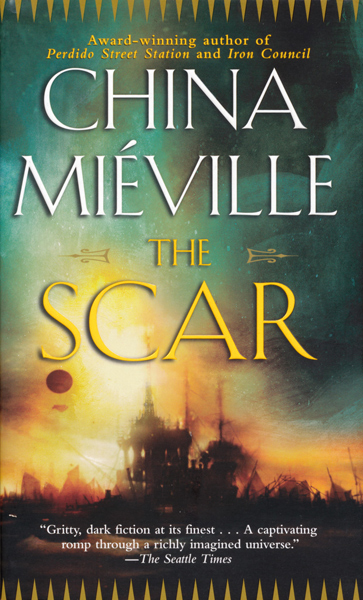
The Scar

One of my friends offered me the loan of The Scar whenever I wanted to borrow it.  When I started Gravity's Rainbow I decided that The Scar would be next.  When I finally made it to the end of Gravity's Rainbow I still wanted to read it (and I had hopes that it would be less stressful).  Right before I started I learned that The Scar is part of a shared world which currently comprises three books and The Scar is the second (!) chronologically of those three.  After some reassurances from my friend that the order did not matter significantly, I embarked on the journey that was The Scar.


China Miéville has crafted a full world that he calls Bas-Lag.  There are so many different species and cultures that it feels like this is a world that has been fleshed out a lot more than just three books.  For some authors, an attempt to do something like this would seem confusing at best and at worst like the author was being needlessly complex but China Miéville pulls it off.

I have to say, the end of the book felt a little contrived but after I started to get miffed about how contrived it was, the characters started talking about how they felt certain events were a little contrived.  That made me feel better and added an interesting dimension to some of the characters.

This book has some great plot twists.  Some characters aren't who they seem and some items are not what they seem.  Allegiances are murky and twisted. I will admit that I am not one of those people that has an easy time predicting plot twists, but there were a lot of surprises for me in this book.

The places within the world that the book goes are fantastical but at the same time plausible.  The battle scenes are very well done and make me wish that there were more of them. I am sure at some point in the near future I will be reading more by him.

Overall, I would give this book a 91%.